뒤로

Proteins, Nucleic Acids, Carbohydrates, and Lipids - General Biology

컨트롤 버튼이 '내비게이션' 모드로 변경되었습니다.
1/18
  • What are proteins made of?

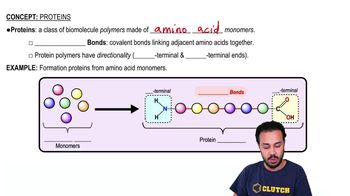
    Proteins are made of amino acids linked by peptide bonds forming polypeptide chains.
  • What determines a protein's function?

    A protein's function is determined by its unique 3D structure, which depends on its amino acid sequence.
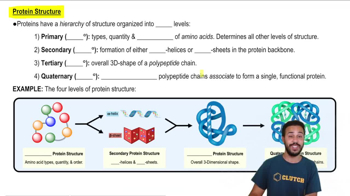
  • Name the four levels of protein structure.

    • Primary: amino acid sequence
    • Secondary: alpha helices and beta sheets
    • Tertiary: 3D folding
    • Quaternary: multiple polypeptide subunits
  • What are nucleic acids composed of?

    Nucleic acids are polymers of nucleotides, each containing a sugar, phosphate group, and nitrogenous base.
  • Difference between DNA and RNA nucleotides?

    DNA contains deoxyribose sugar and bases A, T, C, G; RNA contains ribose sugar and bases A, U, C, G.
  • What is the main function of DNA?

    DNA stores and transmits genetic information used for protein synthesis.
  • What are carbohydrates made of?

    Carbohydrates are made of carbon, hydrogen, and oxygen atoms, usually in a 1:2:1 ratio.
  • Name the three main types of carbohydrates.

    • Monosaccharides: simple sugars
    • Disaccharides: two monosaccharides linked
    • Polysaccharides: long chains of monosaccharides
  • What is the function of polysaccharides like starch and glycogen?

    They serve as energy storage molecules in plants (starch) and animals (glycogen).
  • What are lipids primarily composed of?

    Lipids are mostly composed of carbon and hydrogen atoms and are hydrophobic.
  • Name the main types of lipids.

    • Fats (triglycerides)
    • Phospholipids
    • Steroids
  • Difference between saturated and unsaturated fatty acids?

    Saturated fatty acids have no double bonds and are solid at room temperature; unsaturated have one or more double bonds and are liquid.
  • What is the role of phospholipids in cells?

    Phospholipids form the cell membrane bilayer, with hydrophilic heads and hydrophobic tails.
  • What is a steroid and give an example?

    Steroids are lipids with a four-ring carbon structure; cholesterol is a common example.
  • How do nucleotides link to form nucleic acids?

    Nucleotides link via phosphodiester bonds between the phosphate of one and the sugar of the next.
  • What is the function of RNA?

    RNA plays roles in protein synthesis and gene regulation.
  • What type of bond links monosaccharides in disaccharides?

    Monosaccharides are linked by glycosidic bonds to form disaccharides.
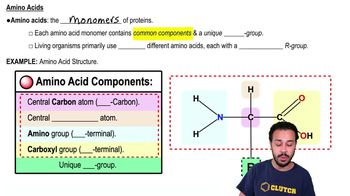
  • What determines the properties of amino acids?

    The side chain (R group) determines an amino acid's properties and behavior.