 뒤로
Protists and Their Diversity in General Biology
 03:23

이 집합의 용어 (28)
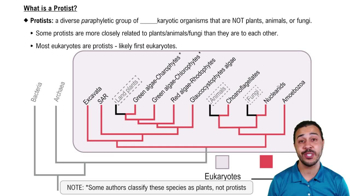
Protists are mostly unicellular eukaryotes with diverse structures and functions, more complex than prokaryotes.
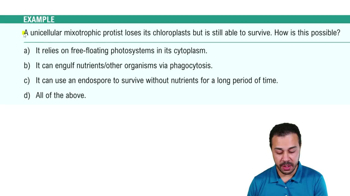
Protists can be photoautotrophs, heterotrophs, or mixotrophs, combining photosynthesis and heterotrophic nutrition.
Protists act as producers in aquatic ecosystems and as symbionts or parasites in various habitats.
Dinoflagellates nourish coral polyps, helping build coral reefs through symbiotic relationships.
Plasmodium is the apicomplexan protist responsible for malaria.
The four supergroups are Excavata, SAR, Archaeplastida, and Unikonta.
Excavata have an excavated feeding groove, modified mitochondria, unique flagella, and many are parasites.
Diplomonads have reduced mitochondria called mitosomes, two equal-sized nuclei, multiple flagella, and are often parasites like Giardia intestinalis.
Parabasalids have hydrogenosomes for anaerobic energy, include Trichomonas vaginalis, a sexually transmitted parasite.
Euglenozoans include predatory heterotrophs, photosynthetic autotrophs, mixotrophs, and parasites, with a spiral rod inside their flagella.
Kinetoplastids are free-living or parasitic; Trypanosoma causes sleeping sickness and evades immunity by changing surface proteins.
Stramenopiles have a hairy and a smooth flagellum, include diatoms, golden algae, and brown algae, many are photosynthetic.
Diatoms are unicellular algae with glass-like walls of silicon dioxide, major phytoplankton components.
Brown algae are large, multicellular seaweeds with rootlike holdfasts, stemlike stipes, and leaflike blades but lack true tissues.
Alternation of generations is a life cycle with multicellular haploid (gametophyte) and diploid (sporophyte) stages.
Alveolates have membrane-enclosed sacs (alveoli) under the plasma membrane and include dinoflagellates, apicomplexans, and ciliates.
Dinoflagellates have two flagella, cellulose plates, and are important aquatic phototrophs, mixotrophs, and heterotrophs.
Apicomplexans are parasites like Plasmodium, which causes malaria and requires both mosquitoes and humans to complete its life cycle.
Ciliates use cilia for movement and feeding and have two types of nuclei: micronuclei for genetic exchange and macronuclei for everyday functions.
Rhizarians are mostly amoebas with threadlike pseudopodia, including radiolarians, forams, and cercozoans.
Forams have porous shells called tests, use pseudopodia for movement and feeding, and often host symbiotic algae.
Archaeplastida includes red algae, green algae, and plants, sharing plant-type chloroplasts and photosynthetic pigments.
Phycoerythrin is the accessory pigment that gives red algae their reddish color.
Green algae have grass-green chloroplasts and are closely related to plants; they exhibit diverse life cycles and complexity.
Unikonta includes animals, fungi, and some protists like amoebozoans, characterized by lobe- or tube-shaped pseudopodia.
Slime molds are amoebozoans that form spore-producing fruiting bodies, with plasmodial and cellular types exhibiting convergent evolution with fungi.
Tubulinids are diverse amoebozoans with lobe-shaped pseudopodia, common in soil and aquatic environments, feeding on bacteria and protists.
Entamoeba histolytica causes amebic dysentery, a major cause of death from eukaryotic parasites.