 뒤로
Speciation and Species Concepts in General Biology
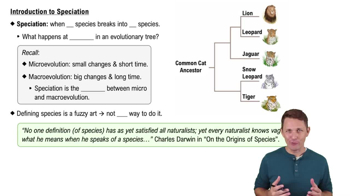
 03:03

이 집합의 용어 (23)
Speciation is the process by which new species arise from ancestral populations through genetic divergence and interruption of gene flow, leading to evolutionary independence.
A species is a group of populations that are genetically similar and evolutionarily independent.
Gene flow is the movement of alleles between populations, maintaining genetic similarity.
Genetic divergence occurs due to mutation, natural selection, and genetic drift causing populations to evolve independently.
The Biological Species Concept defines species as groups of interbreeding populations that are reproductively isolated from others.
Reproductive isolation is the lack of gene flow between populations, preventing interbreeding or production of viable, fertile offspring.
Prezygotic isolation prevents mating or fertilization; postzygotic isolation results in hybrid offspring that do not survive or reproduce.
The Morphospecies Concept distinguishes species based on morphological differences, useful when genetic data is unavailable.
Polymorphic species have multiple forms; cryptic species are indistinguishable by appearance but differ genetically or behaviorally.
The Phylogenetic Species Concept identifies species as the smallest monophyletic groups sharing unique evolutionary traits (synapomorphies).
A monophyletic group includes an ancestral population and all its descendants.
A synapomorphy is a homologous trait found in a common ancestor and all its descendants.
Allopatric speciation occurs when populations become geographically isolated, preventing gene flow and leading to speciation.
Dispersal is movement to a new location; vicariance is a physical barrier splitting a population.
Sympatric speciation occurs without geographic isolation, often through disruptive selection or chromosomal mutations causing reproductive isolation.
Disruptive selection favors different ecological niches or mate preferences within the same area, promoting reproductive isolation.
Polyploidy is having more than two chromosome sets; autopolyploid arises from chromosome doubling within one species, allopolyploid from hybridization between species.
Outcomes include fusion (populations interbreed), reinforcement (selection against hybrids), and formation of hybrid zones.
Advantages: defines evolutionary independence via reproductive isolation. Disadvantages: not applicable to asexual or fossil species; hard to assess if populations don't overlap.
Limitations include subjectivity, inability to identify cryptic species, and misclassification of polymorphic species as multiple species.
It is based on testable evolutionary history and monophyly, but few well-studied phylogenies exist.
Examples include temporal isolation (different breeding seasons), habitat isolation, behavioral differences, mechanical incompatibility, and gametic incompatibility.
Examples include hybrid inviability (offspring do not survive) and hybrid sterility (offspring cannot reproduce).