 뒤로
Transcription and RNA Processing in Biology
 07:44

이 집합의 용어 (20)
Initiation, elongation, and termination.
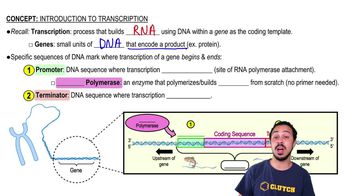
In bacteria, RNA polymerase binds directly to the promoter DNA. In eukaryotes, transcription factors bind first and then recruit RNA polymerase II.
They bind to the promoter DNA to help orient RNA polymerase II and form the transcription initiation complex.
RNA polymerase adds nucleotides to the 3' OH end of the growing RNA strand, synthesizing RNA in the 5' to 3' direction.
The -35 and -10 sequences (Pribnow box) upstream of the transcription start site.
A conserved DNA sequence (~25 nucleotides upstream) in eukaryotic promoters that helps position RNA polymerase II.
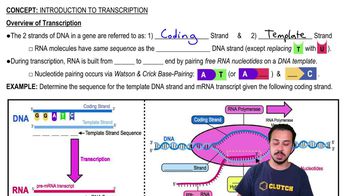
The template strand is the DNA strand that is complementary and antiparallel to the RNA transcript.
The coding strand has the same sequence as the RNA (except T instead of U), while the template strand is used by RNA polymerase to synthesize RNA.
It signals transcription termination and addition of the poly(A) tail to the mRNA.
By formation of an mRNA hairpin structure at the termination sequence, causing RNA polymerase to detach.
DNA sequences on the same molecule as the gene they regulate, such as promoters and enhancers.
Proteins, like transcription factors, that regulate genes and can act at a distance from the gene they were transcribed from.
RNA Pol I: transcribes large rRNA; RNA Pol II: transcribes mRNA and snRNAs; RNA Pol III: transcribes tRNA and small rRNA.
Prokaryotes have no RNA processing; eukaryotes add a 5' cap, splice introns, add a 3' poly(A) tail, and export mRNA from the nucleus.
It prevents mRNA degradation, facilitates nuclear export, and enhances translation efficiency.
It protects mRNA from degradation and aids in nuclear export and translation.
Small nuclear RNAs (snRNAs) in the spliceosome base pair complementarily with conserved intron sequences.
They can cause introns to be retained, leading to premature stop codons and truncated proteins.
RNA polymerase moves downstream from the promoter, synthesizing RNA 5' to 3'.
The location and orientation of the promoter relative to the gene.