 뒤로
Types of Cell Junctions in General Biology
 05:33

이 집합의 용어 (20)
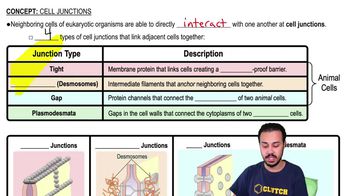
Tight junctions prevent leakage between cells by sealing adjacent cell membranes tightly together.
Desmosomes, also called anchor junctions, provide strong adhesion between cells using intermediate filaments.
Gap junctions allow the flow of ions and small molecules directly between adjacent cells for communication.
Plasmodesmata are channels that connect plant cells, enabling communication and transport of materials.
Tight junctions prevent leakage by creating a seal between adjacent cells.
Desmosomes use intermediate filaments to anchor cells together strongly.
Ions and small molecules pass through gap junctions to facilitate intercellular communication.
Plasmodesmata are plant cell channels, while gap junctions are found in animal cells; both allow intercellular transport.
Desmosomes provide mechanical strength by anchoring cells together, maintaining tissue stability.
Gap junctions primarily facilitate communication by allowing molecule exchange between cells.
Tight junctions form a continuous seal around cells to block passage of substances.
Plasmodesmata serve as channels for communication and transport between plant cells.
Desmosomes use intermediate filaments to connect the cytoskeletons of adjacent cells.
By preventing leakage, tight junctions help maintain distinct environments on either side of a tissue layer.
Desmosomes provide strong adhesion; tight junctions create a seal to prevent leakage.
Gap junctions allow direct exchange of ions and small molecules through channels.
Plasmodesmata enable transport and communication by connecting the cytoplasm of adjacent plant cells.
Intermediate filaments provide structural support, anchoring desmosomes to the cell's cytoskeleton.
Tight junctions maintain selective barriers by sealing spaces between cells.
Small molecules and ions can pass through gap junctions to facilitate cell signaling.