
Ch. 1 - Evolution, the Themes of Biology, and Scientific Inquiry
Campbell - Campbell Biology 12th Edition
Urry12th EditionCampbell BiologyISBN: 9785794169850당신이 사용하는 게 아니라요?교과서 변경
1장, 문제 6

Which of the following is an example of qualitative data?
a. The fish swam in a zigzag motion.
b. The contents of the stomach are mixed every 20 seconds.
c. The temperature decreased from 20°C to 15°C.
d. The six pairs of robins hatched an average of three chicks each.

검증된 단계별 안내
1
Understand the difference between qualitative and quantitative data. Qualitative data describes qualities or characteristics, often using descriptive language, while quantitative data involves numbers and measurements.
Examine option a: 'The fish swam in a zigzag motion.' This statement describes the pattern of movement without using numbers, making it qualitative data.
Examine option b: 'The contents of the stomach are mixed every 20 seconds.' This statement uses a numerical measurement (20 seconds), indicating quantitative data.
Examine option c: 'The temperature decreased from 20°C to 15°C.' This statement involves numerical values (20°C and 15°C), indicating quantitative data.
Examine option d: 'The six pairs of robins hatched an average of three chicks each.' This statement uses numerical values (six pairs, three chicks), indicating quantitative data.

비슷한 문제에 대한 검증된 영상 답변:

이 영상 해법은 위 문제에 도움이 된다고 튜터들이 추천한 것입니다.
영상 길이:
2m

주요 개념

질문에 올바르게 답하기 위해 반드시 이해해야 하는 핵심 개념들은 다음과 같습니다.

Qualitative Data

Qualitative data refers to non-numeric information that describes characteristics or qualities. It is often used to capture observations that are subjective, such as behaviors, patterns, or descriptions. In the context of the question, qualitative data is exemplified by the description of the fish swimming in a zigzag motion, as it conveys a pattern without numerical measurement.
추천 영상:
03:26
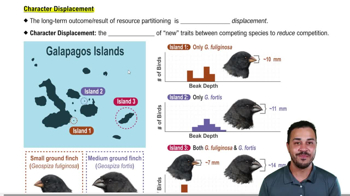
Character Displacement

Quantitative Data

Quantitative data involves numerical values that can be measured and quantified. This type of data is used to express quantities, amounts, or ranges, and is often used for statistical analysis. In the question, options b, c, and d represent quantitative data, as they provide specific numerical measurements or averages.
추천 영상:
03:26
Character Displacement

Data Collection in Biology

Data collection in biology involves gathering information to understand biological processes and phenomena. It can include both qualitative and quantitative data, depending on the research focus. Qualitative data helps describe behaviors and patterns, while quantitative data provides measurable evidence. Understanding the type of data collected is crucial for interpreting biological studies and experiments.
추천 영상:
04:08
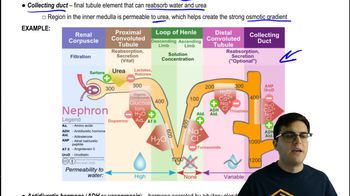
Distal Tubule and Collecting Duct
관련 실천
교과서 질문

Which of the following statements best distinguishes hypotheses from theories in science?

a. Theories are hypotheses that have been proved.

b. Hypotheses are guesses; theories are correct answers.

c. Hypotheses usually are relatively narrow in scope; theories have broad explanatory power.

d. Theories are proved true; hypotheses are often contradicted by experimental results.

4386
views
교과서 질문

Draw a biological hierarchy similar to the one in Figure 1.3 but using a coral reef as the ecosystem, a fish as the organism, its stomach as the organ, and DNA as the molecule. Include all levels in the hierarchy.

<IMAGE>

1328
views
교과서 질문

Which of the following best demonstrates the unity among all organisms?

a. Emergent properties

b. Descent with modification

c. The structure and function of DNA

d. Natural selection

1776
views
교과서 질문

A controlled experiment is one that

a. Proceeds slowly enough that a scientist can make careful records of the results.

b. Tests experimental and control groups in parallel.

c. Is repeated many times to make sure the results are accurate.

d. Keeps all variables constant.

2769
views
교과서 질문

Which sentence best describes the logic of scientific inquiry?

a. If I generate a testable hypothesis, tests and observations will support it.

b. If my prediction is correct, it will lead to a testable hypothesis.

c. If my observations are accurate, they will support my hypothesis.

d. If my hypothesis is correct, I can expect certain test results.

3392
views