
Ch. 2 - The Chemical Context of Life
Campbell - Campbell Biology 12th Edition
Urry12th EditionCampbell BiologyISBN: 9785794169850당신이 사용하는 게 아니라요?교과서 변경
2장, 문제 7

The atomic number of sulfur is 16. Sulfur combines with hydrogen by covalent bonding to form a compound, hydrogen sulfide. Based on the number of valence electrons in a sulfur atom, predict the molecular formula of the compound.
a. HS
b. HS2
c. H2S
d. H4S

검증된 단계별 안내
1
Identify the number of valence electrons in a sulfur atom. Sulfur is in group 16 of the periodic table, which means it has 6 valence electrons.
Determine how many more electrons sulfur needs to achieve a full outer shell. A full outer shell typically has 8 electrons, so sulfur needs 2 more electrons.
Consider how sulfur can achieve a full outer shell through covalent bonding. Each hydrogen atom can share one electron with sulfur, allowing sulfur to gain the 2 additional electrons it needs.
Predict the number of hydrogen atoms needed to bond with one sulfur atom. Since sulfur needs 2 more electrons, it will form covalent bonds with 2 hydrogen atoms.
Write the molecular formula based on the number of hydrogen atoms bonding with sulfur. The formula is H2S, indicating two hydrogen atoms are bonded to one sulfur atom.

비슷한 문제에 대한 검증된 영상 답변:

이 영상 해법은 위 문제에 도움이 된다고 튜터들이 추천한 것입니다.
영상 길이:
2m

주요 개념

질문에 올바르게 답하기 위해 반드시 이해해야 하는 핵심 개념들은 다음과 같습니다.

Atomic Number and Valence Electrons

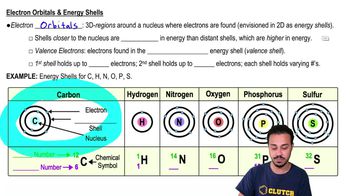
The atomic number of an element indicates the number of protons in its nucleus, which equals the number of electrons in a neutral atom. Sulfur has an atomic number of 16, meaning it has 16 electrons. The valence electrons are those in the outermost shell, and sulfur has six valence electrons, crucial for determining its bonding behavior.
추천 영상:
09:44
Electron Orbitals & Energy Shells

Covalent Bonding

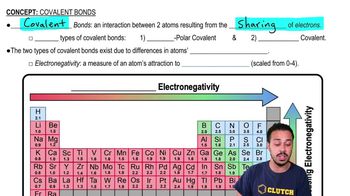
Covalent bonding involves the sharing of electron pairs between atoms. Sulfur forms covalent bonds with hydrogen by sharing its valence electrons to achieve a stable electron configuration. Understanding covalent bonding helps predict how sulfur and hydrogen atoms combine to form molecules like hydrogen sulfide.
추천 영상:
04:28
Covalent Bonds

Molecular Formula Prediction

The molecular formula of a compound represents the number and type of atoms in a molecule. Sulfur needs two additional electrons to complete its valence shell, which it can achieve by forming two covalent bonds with hydrogen atoms. Therefore, the molecular formula for hydrogen sulfide is H2S, indicating two hydrogen atoms bonded to one sulfur atom.
추천 영상:
08:22
Predictions, Hypotheses, & Theories
관련 실천
교과서 질문

Which of the following statements correctly describes any chemical reaction that has reached equilibrium?

a. The concentrations of products and reactants are equal.

b. The reaction is now irreversible.

c. Both forward and reverse reactions have halted.

d. The rates of the forward and reverse reactions are equal.

2165
views
교과서 질문

Which statement is true of all atoms that are anions?

a. The atom has more electrons than protons.

b. The atom has more protons than electrons.

c. The atom has fewer protons than does a neutral atom of the same element.

d. The atom has more neutrons than protons.

2372
views
교과서 질문

Draw Lewis dot structures for each hypothetical molecule shown below, using the correct number of valence electrons for each atom. Determine which molecule makes sense because each atom has a complete valence shell, and each bond has the correct number of electrons. Explain what makes the other molecule nonsensical, considering the number of bonds each type of atom can make.

2439
views
교과서 질문

What coefficients must be placed in the following blanks so that all atoms are accounted for in the products?

C6H12O6 → _____C2H6O + _____CO2

a. 2; 1

b. 3; 1

c. 1; 3

d. 2; 2

2435
views
교과서 질문

We can represent atoms by listing the number of protons, neutrons, and electrons—for example, 2p+, 2p+,2n0,2e− for helium. Which of the following represents the 18O isotope of oxygen?

a. 7p+, 2n0, 9e−

b. 8p+, 10n0, 8e−

c. 9p+, 9n0, 9e−

d. 10p+, 8n0, 9e-

2889
views