
Ch. 24 - The Origin of Species
Campbell - Campbell Biology 12th Edition
Urry12th EditionCampbell BiologyISBN: 9785794169850당신이 사용하는 게 아니라요?교과서 변경
24장, 문제 2

Males of different species of the fruit fly Drosophila that live in the same parts of the Hawaiian Islands have different elaborate courtship rituals. These rituals involve fighting other males and making stylized movements that attract females. What type of reproductive isolation does this represent?
a. Habitat isolation
b. Temporal isolation
c. Behavioral isolation
d. Gametic isolation

검증된 단계별 안내
1
Begin by understanding the concept of reproductive isolation, which prevents different species from interbreeding and producing fertile offspring.
Identify the types of reproductive isolation: habitat isolation, temporal isolation, behavioral isolation, and gametic isolation.
Consider the details provided in the problem: males of different species have elaborate courtship rituals involving fighting and stylized movements.
Recognize that these courtship rituals are specific behaviors that attract females of the same species, indicating a form of isolation based on behavior.
Conclude that the type of reproductive isolation described in the problem is behavioral isolation, as it involves specific actions and signals that prevent interbreeding between species.

비슷한 문제에 대한 검증된 영상 답변:

이 영상 해법은 위 문제에 도움이 된다고 튜터들이 추천한 것입니다.
영상 길이:
2m

주요 개념

질문에 올바르게 답하기 위해 반드시 이해해야 하는 핵심 개념들은 다음과 같습니다.

Reproductive Isolation

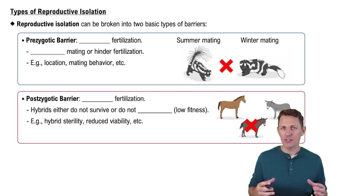
Reproductive isolation refers to mechanisms that prevent species from mating with each other, thus maintaining species boundaries. It can be prezygotic, preventing fertilization, or postzygotic, affecting the viability of offspring. Understanding these mechanisms is crucial for studying speciation and evolutionary biology.
추천 영상:
가이드 코스
02:47
Types of Reproductive Isolation

Behavioral Isolation

Behavioral isolation is a form of prezygotic reproductive isolation where differences in mating rituals or behaviors prevent interbreeding between species. In the case of Drosophila, distinct courtship rituals act as barriers, ensuring that mating occurs only within the same species, thus maintaining species integrity.
추천 영상:
06:41
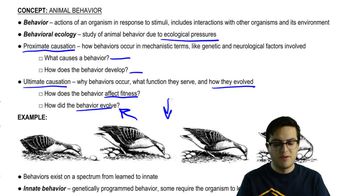
Behavior

Courtship Rituals

Courtship rituals are specific behaviors exhibited by animals to attract mates, often involving complex displays or actions. These rituals are crucial for sexual selection and can lead to behavioral isolation when they differ significantly between species, as seen in the Drosophila species in Hawaii.
추천 영상:
05:37
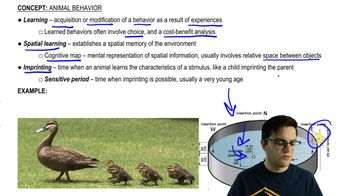
Learning and Communication
관련 실천
교과서 질문

Which of the following factors would be the most likely to contribute to allopatric speciation?

a. The separated population is large, and genetic drift occurs.

b. Selection pressures in the isolated population are similar to those in the ancestral population.

c. Gene flow between the two populations is extensive.

d. Different mutations begin to distinguish the gene pools of the separated populations.

304
views
교과서 질문

Bird guides once listed the myrtle warbler and Audubon's warbler as distinct species. Recently, these birds have been classified as eastern and western forms of a single species, the yellow-rumped warbler. Which of the following pieces of evidence, if true, would be cause for this reclassification?

a. The two forms interbreed often in nature, and their offspring survive and reproduce well.

b. The two forms live in similar habitats and have similar food requirements.

c. The two forms have many genes in common.

d. The two forms are very similar in appearance.

1419
views
교과서 질문

The largest unit within which gene flow can readily occur is a

a. Population.

b. Species.

c. Genus.

d. Hybrid.

1236
views
교과서 질문

According to the punctuated equilibria model:

a. Given enough time, most existing species will branch gradually into new species.

b. Most new species accumulate their unique features relatively rapidly as they come into existence, then change little for the rest of their duration as a species.

c. Most evolution occurs in sympatric populations.

d. Speciation is usually due to a single mutation.

1624
views