Ch. 26 - Phylogeny and the Tree of Life
Campbell - Campbell Biology 12th Edition
Urry12th EditionCampbell BiologyISBN: 9785794169850당신이 사용하는 게 아니라요?교과서 변경
26장, 문제 7

The relative lengths of the frog and mouse branches in the phylogenetic tree in Figure 26.13 indicate that:
<IMAGE>
a. Frogs evolved before mice
b. Mice evolved before frogs
c. The homolog has evolved more rapidly in mice
d. The homolog has evolved more slowly in mice

검증된 단계별 안내
1
Examine the phylogenetic tree provided in the image. Note that the tree represents evolutionary relationships among species, with branch lengths indicating the amount of genetic change or evolutionary divergence.
Identify the branches corresponding to the frog and mouse. Observe that the branch length for the mouse is longer than that of the frog.
Understand that longer branch lengths in a phylogenetic tree typically indicate a greater amount of genetic change or faster evolutionary divergence over time.
Interpret the relative branch lengths: the longer branch for the mouse suggests that the homolog (gene or trait being studied) has evolved more rapidly in mice compared to frogs.
Conclude that the correct answer is related to the rate of evolution of the homolog, specifically that the homolog has evolved more rapidly in mice.

비슷한 문제에 대한 검증된 영상 답변:

이 영상 해법은 위 문제에 도움이 된다고 튜터들이 추천한 것입니다.
영상 길이:
49s

주요 개념

질문에 올바르게 답하기 위해 반드시 이해해야 하는 핵심 개념들은 다음과 같습니다.

Phylogenetic Tree

A phylogenetic tree is a diagram that represents evolutionary relationships among various biological species based on similarities and differences in their physical or genetic characteristics. The branches indicate the lineage and the relative lengths can suggest the amount of evolutionary change or time elapsed.
추천 영상:
가이드 코스
04:13
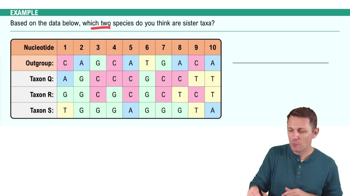
Building Phylogenetic Trees Example 2

Homologous Genes

Homologous genes are genes inherited from a common ancestor that may have similar sequences and functions across different species. The rate of evolution of these genes can vary, affecting the length of branches in a phylogenetic tree, which reflects the genetic divergence over time.
추천 영상:
08:09
Homologous Chromosomes

Evolutionary Rate

Evolutionary rate refers to the speed at which genetic changes accumulate in a species over time. In phylogenetic trees, longer branches typically indicate a faster rate of evolution, while shorter branches suggest slower evolutionary changes. This concept helps in interpreting the relative lengths of branches in the tree.
추천 영상:
가이드 코스
02:45
History of Evolutionary Theory Example 1