
Ch. 24 - The Origin of Species
Campbell - Campbell Biology 11th Edition
Urry11th EditionCampbell BiologyISBN: 9789357423311당신이 사용하는 게 아니라요?교과서 변경
24장, 문제 5

Which of the following factors would not contribute to allopatric speciation?
a. The separated population is small, and genetic drift occurs.
b. The isolated population is exposed to different selection pressures than the ancestral population.
c. Different mutations begin to distinguish the gene pools of the separated populations.
d. Gene flow between the two populations is extensive.

검증된 단계별 안내
1
Understand the concept of allopatric speciation: Allopatric speciation occurs when populations of the same species become geographically isolated, leading to genetic divergence and the formation of new species. Key factors include lack of gene flow, genetic drift, mutations, and differing selection pressures.
Analyze each option to determine its relevance to allopatric speciation: For example, genetic drift (option a) can lead to changes in allele frequencies in small populations, contributing to speciation. Similarly, differing selection pressures (option b) and mutations (option c) can drive divergence between populations.
Focus on the role of gene flow (option d): Gene flow involves the exchange of genetic material between populations. Extensive gene flow counteracts genetic divergence by homogenizing the gene pools of the populations, which would prevent allopatric speciation.
Compare the options: Identify which factor does not align with the mechanisms of allopatric speciation. Extensive gene flow (option d) directly opposes the isolation required for speciation, making it the factor that would not contribute to allopatric speciation.
Conclude that the correct answer is the factor that prevents genetic divergence and speciation, which is extensive gene flow (option d).

비슷한 문제에 대한 검증된 영상 답변:

이 영상 해법은 위 문제에 도움이 된다고 튜터들이 추천한 것입니다.
영상 길이:
1m

주요 개념

질문에 올바르게 답하기 위해 반드시 이해해야 하는 핵심 개념들은 다음과 같습니다.

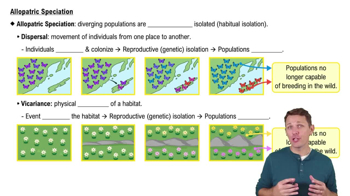
Allopatric Speciation

Allopatric speciation occurs when a population is geographically separated, leading to reproductive isolation. This separation can result from physical barriers like mountains or rivers, preventing gene flow between groups. Over time, the isolated populations may evolve independently, potentially leading to the emergence of new species.
추천 영상:
가이드 코스
03:53
Allopatric Speciation

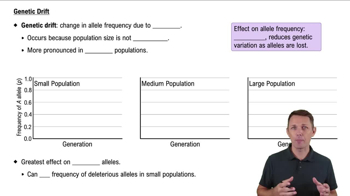
Genetic Drift

Genetic drift is a mechanism of evolution that refers to random changes in allele frequencies within a population, particularly in small populations. It can lead to significant genetic divergence between separated populations, contributing to speciation. This process can result in the loss of genetic variation and the fixation of certain traits purely by chance.
추천 영상:

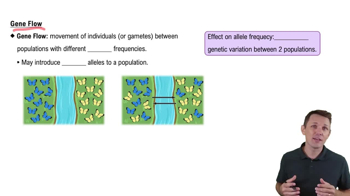
Gene Flow

Gene flow is the transfer of genetic material between populations through migration and interbreeding. Extensive gene flow between two populations can counteract the effects of speciation by homogenizing their gene pools, making it less likely for them to diverge into separate species. In the context of allopatric speciation, reduced gene flow is essential for the process to occur.
추천 영상:
관련 실천
교과서 질문

Bird guides once listed the myrtle warbler and Audubon's warbler as distinct species. Recently, these birds have been classified as eastern and western forms of a single species, the yellow-rumped warbler. Which of the following pieces of evidence, if true, would be cause for this reclassification?

a. The two forms interbreed often in nature, and their offspring survive and reproduce well.

b. The two forms live in similar habitats and have similar food requirements.

c. The two forms have many genes in common.

d. The two forms are very similar in appearance.

1419
views
교과서 질문

Males of different species of the fruit fly Drosophila that live in the same parts of the Hawaiian Islands have different elaborate courtship rituals. These rituals involve fighting other males and making stylized movements that attract females. What type of reproductive isolation does this represent?

a. Habitat isolation

b. Temporal isolation

c. Behavioral isolation

d. Gametic isolation

1528
views
교과서 질문

Plant species A has a diploid chromosome number of 12. Plant species B has a diploid number of 16. A new species, C, arises as an allopolyploid from A and B. The diploid number for species C would probably be

a. 14

b. 16

c. 28

d. 56

1569
views
교과서 질문

According to the punctuated equilibria model:

a. Given enough time, most existing species will branch gradually into new species.

b. Most new species accumulate their unique features relatively rapidly as they come into existence, then change little for the rest of their duration as a species.

c. Most evolution occurs in sympatric populations.

d. Speciation is usually due to a single mutation.

1624
views