Ch. 43 - The Immune System
Campbell - Campbell Biology 11th Edition
Urry11th EditionCampbell BiologyISBN: 9789357423311당신이 사용하는 게 아니라요?교과서 변경
43장, 문제 4

Which of the following statements is not true?
a. An antibody has more than one antigen-binding site.
b. A lymphocyte has receptors for multiple different antigens.
c. An antigen can have different epitopes.
d. A liver or muscle cell makes one class of MHC molecule.

검증된 단계별 안내
1
Understand the role of antibodies: Antibodies are proteins produced by the immune system to identify and neutralize foreign objects like bacteria and viruses. Each antibody has multiple antigen-binding sites, typically two, allowing it to bind to antigens.
Examine lymphocyte receptors: Lymphocytes, such as B cells and T cells, have receptors on their surfaces. Each lymphocyte is specific to a single antigen, meaning it has receptors for only one type of antigen, not multiple different antigens.
Explore antigen structure: Antigens are substances that can induce an immune response. They can have multiple epitopes, which are specific parts of the antigen that antibodies or receptors bind to.
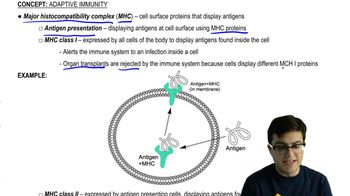
Review MHC molecules: Major Histocompatibility Complex (MHC) molecules are proteins found on the surface of cells that present antigen fragments to T cells. Different cells express different classes of MHC molecules. For example, liver or muscle cells typically express MHC class I molecules.
Identify the incorrect statement: Based on the understanding of antibodies, lymphocytes, antigens, and MHC molecules, determine which statement does not align with biological principles. Focus on the statement about lymphocyte receptors, as it contradicts the specificity of lymphocytes to a single antigen.

비슷한 문제에 대한 검증된 영상 답변:

이 영상 해법은 위 문제에 도움이 된다고 튜터들이 추천한 것입니다.
영상 길이:
5m

주요 개념

질문에 올바르게 답하기 위해 반드시 이해해야 하는 핵심 개념들은 다음과 같습니다.

Antibody Structure

Antibodies are Y-shaped proteins produced by B cells that have multiple antigen-binding sites, typically two, allowing them to bind to specific antigens. These binding sites are located at the tips of the 'Y' and are highly variable, enabling the immune system to recognize a vast array of antigens.
추천 영상:
04:25
Community Structure

Lymphocyte Receptors

Lymphocytes, such as B cells and T cells, have receptors that are specific to one type of antigen. Each lymphocyte is equipped with receptors that recognize a unique antigen, ensuring a targeted immune response. This specificity is crucial for the adaptive immune system's ability to remember and respond to pathogens.
추천 영상:
02:28
Intracellular Receptors

Major Histocompatibility Complex (MHC)

MHC molecules are proteins found on the surface of cells that present antigen fragments to T cells. There are two main classes: MHC class I, present on almost all nucleated cells, and MHC class II, found on specialized antigen-presenting cells. Liver and muscle cells typically express MHC class I molecules, which are essential for presenting intracellular antigens to cytotoxic T cells.
추천 영상:
04:04
Major Histocompatibility Complex
관련 실천
교과서 질문

Which of these is not part of insect immunity?

a. Enzyme activation of pathogen-killing chemicals

b. Activation of natural killer cells

c. Phagocytosis by hemocytes

d. Production of antimicrobial peptides

980
views

교과서 질문

An epitope associates with which part of an antigen receptor or antibody?

a. The tail

b. The heavy-chain constant regions only

c. Variable regions of a heavy chain and light chain combined

d. The light-chain constant regions only

1259
views
교과서 질문

Which of the following should be the same in identical twins?

a. The set of antibodies produced

b. The set of MHC molecules produced

c. The set of T cell antigen receptors produced

d. The set of immune cells eliminated as self-reactive

1468
views
교과서 질문

Which of the following statements is true?

a. An antibody has one antigen-binding site

b. A lymphocyte has receptors for a single antigen

c. Every antigen has a single epitope

d. A liver or muscle cell makes two classes of MHC molecule

1730
views
1
rank
교과서 질문

Which statement best describes the difference between responses of effector B cells (plasma cells) and those of cytotoxic T cells?

a. B cells confer active immunity; cytotoxic T cells confer passive immunity.

b. B cells respond the first time a pathogen is present; cytotoxic T cells respond subsequent times.

c. B cells secrete antibodies against a pathogen; cytotoxic T cells kill pathogen-infected host cells.

d. B cells carry out the cell-mediated response; cytotoxic T cells carry out the humoral response.

2090
views