Ch. 44 - Osmoregulation and Excretion
Campbell - Campbell Biology 11th Edition
Urry11th EditionCampbell BiologyISBN: 9789357423311당신이 사용하는 게 아니라요?교과서 변경
44장, 문제 4

The high osmolarity of the renal medulla is maintained by all of the following except
a. Active transport of salt from the upper region of the ascending limb.
b. The spatial arrangement of juxtamedullary nephrons.
c. Diffusion of urea from the collecting duct.
d. Diffusion of salt from the descending limb of the loop of Henle.

검증된 단계별 안내
1
Understand the role of the renal medulla: The renal medulla is responsible for concentrating urine, and its high osmolarity is crucial for this function.
Identify the mechanisms that contribute to high osmolarity: These include active transport of ions, diffusion of urea, and the unique arrangement of nephron structures.
Examine option a: Active transport of salt occurs in the ascending limb of the loop of Henle, contributing to the osmolarity gradient.
Examine option b: Juxtamedullary nephrons have long loops of Henle that extend deep into the medulla, aiding in the concentration of urine.
Examine option d: Salt does not diffuse from the descending limb; instead, water is reabsorbed here, increasing the concentration of the filtrate. This option does not contribute to the high osmolarity of the medulla.

비슷한 문제에 대한 검증된 영상 답변:

이 영상 해법은 위 문제에 도움이 된다고 튜터들이 추천한 것입니다.
영상 길이:
46s

주요 개념

질문에 올바르게 답하기 위해 반드시 이해해야 하는 핵심 개념들은 다음과 같습니다.

Osmolarity in the Renal Medulla

Osmolarity refers to the concentration of solutes in a solution. In the renal medulla, high osmolarity is crucial for the kidney's ability to concentrate urine. This is achieved through the countercurrent multiplier system, which involves the loop of Henle and the vasa recta, creating a gradient that allows for water reabsorption and urine concentration.
추천 영상:
07:59
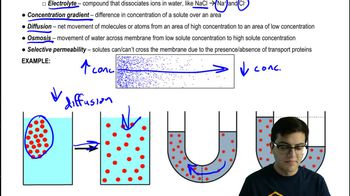
Osmosis and Osmolarity

Countercurrent Multiplier System

The countercurrent multiplier system is a mechanism in the kidneys that helps establish a concentration gradient in the renal medulla. It involves the loop of Henle, where the descending limb is permeable to water but not salt, and the ascending limb actively transports salt but is impermeable to water. This arrangement allows for the efficient reabsorption of water and solutes, maintaining high osmolarity.
추천 영상:
06:28
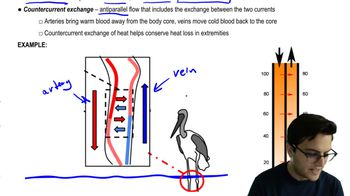
Countercurrent Exchange

Role of Urea in Osmolarity

Urea plays a significant role in maintaining the osmolarity of the renal medulla. It diffuses from the collecting duct into the medullary interstitium, contributing to the osmotic gradient. This process helps in the reabsorption of water from the collecting ducts, further concentrating the urine. Urea recycling is essential for sustaining the high osmolarity necessary for kidney function.
추천 영상:
07:59
Osmosis and Osmolarity