Ch. 13 - Meiosis
Freeman - Biological Science 8th Edition
Freeman8th EditionBiological ScienceISBN: 9780138276263당신이 사용하는 게 아니라요?교과서 변경
13장, 문제 7

Norway rats have 42 chromosomes in their diploid cells. If such a cell enters meiosis, how many chromosomes and double-helical molecules of DNA will be present in each daughter cell at the end of meiosis II?
a. 21 chromosomes and 21 double-helical DNA molecules
b. 21 chromosomes and 42 double-helical DNA molecules
c. 42 chromosomes and 42 double-helical DNA molecules
d. 42 chromosomes and 84 double-helical DNA molecules

검증된 단계별 안내
1
Step 1: Understand the concept of diploid and haploid cells. Diploid cells contain two sets of chromosomes (one from each parent), while haploid cells contain only one set of chromosomes. Meiosis reduces the chromosome number from diploid (2n) to haploid (n).
Step 2: Recall the chromosome number in Norway rats. The diploid number is 42 chromosomes (2n = 42). During meiosis, this number is halved, resulting in haploid cells with 21 chromosomes (n = 21).
Step 3: Consider the process of meiosis. Meiosis consists of two divisions: meiosis I and meiosis II. At the end of meiosis I, homologous chromosomes are separated, but each chromosome still consists of two sister chromatids. At the end of meiosis II, sister chromatids are separated, resulting in daughter cells with single chromatids.
Step 4: Determine the number of double-helical DNA molecules. At the end of meiosis II, each chromosome consists of a single chromatid, which corresponds to one double-helical DNA molecule. Since there are 21 chromosomes in each haploid daughter cell, there will also be 21 double-helical DNA molecules.
Step 5: Match the findings to the answer choices. Based on the analysis, the correct answer is: 21 chromosomes and 21 double-helical DNA molecules.

비슷한 문제에 대한 검증된 영상 답변:

이 영상 해법은 위 문제에 도움이 된다고 튜터들이 추천한 것입니다.
영상 길이:
1m

주요 개념

질문에 올바르게 답하기 위해 반드시 이해해야 하는 핵심 개념들은 다음과 같습니다.

Meiosis

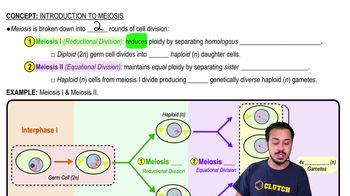
Meiosis is a specialized type of cell division that reduces the chromosome number by half, resulting in four genetically diverse daughter cells. It consists of two sequential divisions: meiosis I and meiosis II. During meiosis I, homologous chromosomes are separated, while meiosis II resembles mitosis, where sister chromatids are separated. This process is crucial for sexual reproduction, producing gametes with half the diploid number of chromosomes.
추천 영상:
04:49
Meiosis I & Meiosis II

Chromosome Number

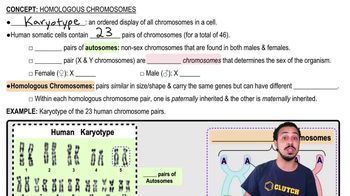
In diploid organisms, chromosomes exist in pairs, with one set inherited from each parent. Norway rats have 42 chromosomes in their diploid cells, meaning they have 21 pairs. During meiosis, the diploid number is halved, resulting in haploid gametes that contain only one chromosome from each pair. Thus, after meiosis, each daughter cell will have 21 chromosomes.
추천 영상:
08:09
Homologous Chromosomes

Double-Helical DNA Molecules

Each chromosome consists of a single double-helical DNA molecule. During the S phase of the cell cycle, before meiosis begins, each chromosome is replicated, resulting in two sister chromatids per chromosome. However, during meiosis II, the sister chromatids are separated, leading to each daughter cell containing one double-helical DNA molecule per chromosome. Therefore, at the end of meiosis II, each daughter cell will have 21 double-helical DNA molecules.
추천 영상:
07:44
Double Fertilization
관련 실천
교과서 질문

Nondisjunction that leads to problems in offspring can occur in:

a. Mitosis

b. Meiosis I only

c. Meiosis I and II

d. Mitosis, meiosis I, and meiosis II

1344
views

교과서 질문

If you followed a woman's cells through meiosis, at what stage of meiosis would the amount of DNA in one of these cells be equal to the amount of DNA in one of her G1 phase (before DNA replication) kidney cells?

987
views
교과서 질문

Triploid (3n) watermelons, which are seedless, are produced by crossing a tetraploid (4n) strain with a diploid (2n) plant. Explain why this mating produces a triploid individual.

1099
views
교과서 질문

Select True or False for each statement.

Sister chromatids are homologous chromosomes.

Non-sister chromatids are found on two different homologs.

Crossing over occurs between sister chromatids.

A chiasma forms between two of the four molecules of double-stranded DNA on duplicated homologous chromosomes.

1165
views
교과서 질문

Meiosis results in independent assortment of egg-derived and sperm-derived chromosomes. If 2𝑛=4 for a given organism, and there is no crossing over, what is the chance that a gamete produced by this diploid organism will receive only sperm-derived chromosomes? In domestic cats, 2𝑛=38. What is the chance that a cat gamete contains only egg-derived chromosomes?

416
views
교과서 질문

A species of rotifer, a small freshwater invertebrate, lost the ability to reproduce sexually millions of years ago. A remarkable feature of its life cycle is the ability to withstand dry conditions. When the rotifer's environment dries out, so does the rotifer, and it can be blown to a new area. Rotifers that land in water will rehydrate and resume an active life. A major pathogen of these rotifers is a species of fungus that cannot survive drying. Some scientists hypothesize that drying rids the rotifers of this pathogen. Design an experimental study to test this hypothesis.

909
views