Ch. 15 - DNA and the Gene: Synthesis and Repair
Freeman - Biological Science 8th Edition
Freeman8th EditionBiological ScienceISBN: 9780138276263당신이 사용하는 게 아니라요?교과서 변경
15장, 문제 8c

What aspect of DNA structure makes it possible for the proteins of nucleotide excision repair to recognize many different types of DNA damage?
(c) the energy differences between correct and incorrect base pairs

검증된 단계별 안내
1
Understand the basic structure of DNA: DNA is composed of two strands forming a double helix, with each strand consisting of a sequence of nucleotides. Each nucleotide includes a sugar, a phosphate group, and a nitrogenous base (adenine, thymine, cytosine, or guanine).
Recognize the importance of base pairing: In the DNA double helix, the nitrogenous bases pair specifically (adenine with thymine, and cytosine with guanine) through hydrogen bonds. This specific pairing is crucial for the integrity and function of DNA.
Identify the role of nucleotide excision repair: Nucleotide excision repair is a mechanism that identifies and repairs damaged DNA. It is capable of recognizing a wide variety of DNA lesions, including those caused by UV light and chemical mutagens.
Explore how DNA damage affects base pairing: Damage to DNA often disrupts the normal base pairing, creating mismatches or distortions in the DNA structure. These disruptions can be recognized by repair proteins.
Explain the energy differences between correct and incorrect base pairs: Correct base pairs have stable hydrogen bonds and fit well within the DNA helix, while incorrect base pairs may have weaker or fewer hydrogen bonds, leading to structural distortions. These energy differences and structural changes help repair proteins identify and target damaged areas for repair.

비슷한 문제에 대한 검증된 영상 답변:

이 영상 해법은 위 문제에 도움이 된다고 튜터들이 추천한 것입니다.
영상 길이:
35s

주요 개념

질문에 올바르게 답하기 위해 반드시 이해해야 하는 핵심 개념들은 다음과 같습니다.

DNA Structure

DNA is composed of two strands forming a double helix, with nucleotides containing bases (adenine, thymine, cytosine, and guanine) paired specifically (A-T and C-G). This structure is crucial for maintaining genetic information and allows for the detection of mismatches or irregularities, which are indicative of damage.
추천 영상:
04:41
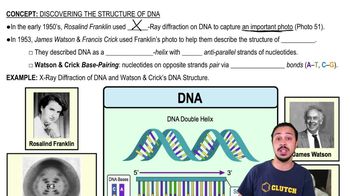
Discovering the Structure of DNA

Nucleotide Excision Repair

Nucleotide excision repair is a DNA repair mechanism that identifies and removes damaged bases, particularly those caused by UV light or chemical exposure. It involves recognizing distortions in the DNA helix, excising the damaged section, and filling the gap with the correct nucleotides, ensuring genomic integrity.
추천 영상:
03:20
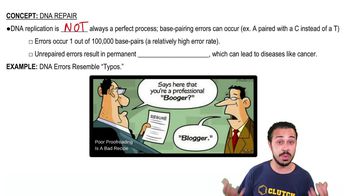
DNA Repair

Base Pairing Energy Differences

Correct base pairs have specific hydrogen bonding patterns and energy levels that stabilize the DNA structure. Incorrect base pairs disrupt this stability, creating energy differences that can be detected by repair proteins. These differences help nucleotide excision repair proteins identify and target damaged or mismatched bases for correction.
추천 영상:
03:48
Bases
관련 실천
교과서 질문

What aspect of DNA structure makes it possible for the proteins of nucleotide excision repair to recognize many different types of DNA damage?

(b) the antiparallel orientation of strands in the double helix

2315
views

교과서 질문

How does telomerase prevent linear chromosomes from shortening during replication?

774
views
교과서 질문

What aspect of DNA structure makes it possible for the proteins of nucleotide excision repair to recognize many different types of DNA damage?

(a) the polarity of each DNA strand

2217
views
교과서 질문

In the late 1950s, Herbert Taylor grew bean root-tip cells in a solution of radioactive thymidine (a precursor to one of the deoxyribonucleotides in DNA) and allowed them to undergo one round of DNA replication. He then transferred the cells to a solution without radioactive thymidine, allowed them to replicate again, and examined their chromosomes for the presence of radioactivity. His results are shown in the following figure, where red indicates a radioactive chromatid.

(a) Draw labeled diagrams of double-stranded DNA molecules that explain the pattern of radioactivity observed in the sister chromatids after the first and second rounds of replication.

724
views
교과서 질문

In the late 1950s, Herbert Taylor grew bean root-tip cells in a solution of radioactive thymidine (a precursor to one of the deoxyribonucleotides in DNA) and allowed them to undergo one round of DNA replication. He then transferred the cells to a solution without radioactive thymidine, allowed them to replicate again, and examined their chromosomes for the presence of radioactivity. His results are shown in the following figure, where red indicates a radioactive chromatid.

(b) What would the results of Taylor's experiment be if eukaryotes used a conservative mode of DNA replication?

1034
views
교과서 질문

What aspect of DNA structure makes it possible for the proteins of nucleotide excision repair to recognize many different types of DNA damage?

(d) the regularity of DNA's structure

2248
views