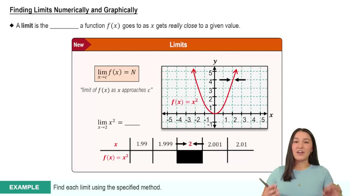
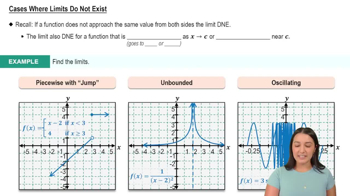
The derivative of a function f at x is \(f'(x) = \lim_{h \to 0} \frac{f(x+h) - f(x)}{h}\).
Power Rule for derivatives
If \(f(x) = x^n\), then \(f'(x) = nx^{n-1}\).
Product Rule
For functions u and v, \((uv)' = u'v + uv'\).
Quotient Rule
For functions u and v, \(\left(\frac{u}{v}\right)' = \frac{u'v - uv'}{v^2}\).
Chain Rule
If y = f(g(x)), then \(\frac{dy}{dx} = f'(g(x)) \cdot g'(x)\).
Derivative of exponential function
The derivative of \(e^x\) is \(e^x\).
Derivative of natural logarithm
The derivative of \(\ln x\) is \(\frac{1}{x}\).
Limit definition of continuity
A function f is continuous at a if \(\lim_{x \to a} f(x) = f(a)\).
Definition of a critical point
A critical point occurs where \(f'(x) = 0\) or \(f'(x)\) does not exist.
First Derivative Test
If changes from positive to negative at c, then f has a local max at c.
Second Derivative Test
If \(f'(c) = 0\) and \(f''(c) > 0\), then f has a local min at c.
Definition of concavity
If \(f''(x) > 0\), f is concave up; if \(f''(x) < 0\), f is concave down.
Definition of inflection point
An inflection point is where the concavity changes, i.e., where \(f''(x) = 0\) and changes sign.
Derivative of sine and cosine
The derivative of \(\sin x\) is \(\cos x\), and the derivative of \(\cos x\) is \(-\sin x\).
Implicit differentiation
Used when y is defined implicitly; differentiate both sides with respect to x and solve for \(\frac{dy}{dx}\).
Derivative of inverse functions
If y = f^{-1}(x), then \(\frac{dy}{dx} = \frac{1}{f'(y)}\).
Limit of a function at infinity
The limit as x approaches infinity describes the end behavior of the function.
L'Hôpital's Rule
If limit results in \(\frac{0}{0}\) or \(\frac{\infty}{\infty}\), then \(\lim_{x \to a} \frac{f(x)}{g(x)} = \lim_{x \to a} \frac{f'(x)}{g'(x)}\) if the latter limit exists.
Definition of average rate of change
Average rate of change of f on [a,b] is \(\frac{f(b) - f(a)}{b - a}\).
Definition of instantaneous rate of change
Instantaneous rate of change at x is the derivative \(f'(x)\).
Equation of the tangent line
At point (a, f(a)), tangent line is \(y = f(a) + f'(a)(x - a)\).
 뒤로
 03:33