 뒤로
Calculus: Functions, Concavity, and Extrema
 02:33

이 집합의 용어 (20)
A function is increasing on an interval if its derivative is positive there, meaning \(f'(x) > 0\).
A function is decreasing on an interval if its derivative is negative there, meaning \(f'(x) < 0\).
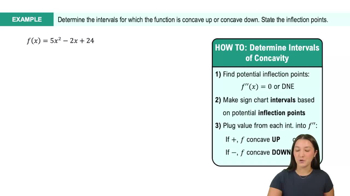
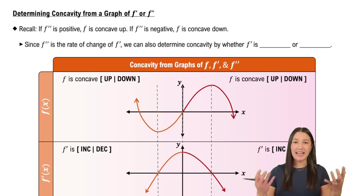
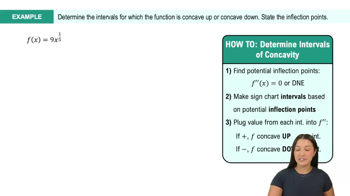
Concavity is determined by the sign of the second derivative: concave up if \(f''(x) > 0\), and concave down if \(f''(x) < 0\).
An inflection point is where the function changes concavity, i.e., where \(f''(x)\) changes sign.
Local extrema are points where a function reaches a local maximum or minimum value compared to nearby points.
Critical points occur where the derivative is zero or undefined: \(f'(x) = 0\) or \(f'(x) \text{ undefined}\).
The First Derivative Test analyzes the sign of \(f'(x)\) around critical points to classify extrema.
If \(f'(c) = 0\) and \(f''(c) > 0\), then local minimum; if \(f''(c) < 0\), then local maximum.
Concave up graphs look like a cup (U-shaped), and concave down graphs look like a cap (∩-shaped).
These points are candidates for inflection points, where concavity may change.
Confirm by checking if \(f''(x)\) changes sign around the point.
The test is inconclusive; further analysis is needed to classify the point.
A local maximum occurs where the function changes from increasing to decreasing; a local minimum occurs where it changes from decreasing to increasing.
The derivative indicates slope; zero slope points (\(f'(x) = 0\)) are potential extrema.
Yes, points where \(f'(x)\) is undefined can also be extrema.
Local extrema are maxima or minima in a neighborhood; absolute extrema are the highest or lowest values on the entire domain.
In concave up regions, the graph lies above the tangent line; in concave down regions, it lies below.
The second derivative measures the curvature or concavity of the function's graph.
Find where \(f'(x) > 0\) (increasing) and \(f'(x) < 0\) (decreasing).
It is an inflection point where the curvature changes sign.