Skip to main content
Calculus
나의 코스
배우기
시험 준비
AI 튜터
학습 가이드
교과서적 해결책
플래시카드
탐험해 보세요
앱을 사용해 보세요
나의 코스
배우기
시험 준비
AI 튜터
학습 가이드
교과서적 해결책
플래시카드
탐험해 보세요
앱을 사용해 보세요
뒤로
Calculus: Limits
카드를 뒤집기 위해 탭할 수 있습니다.
What is the definition of a limit in calculus?
카드를 뒤집기 위해 탭할 수 있습니다.
👆
What is the definition of a limit in calculus?
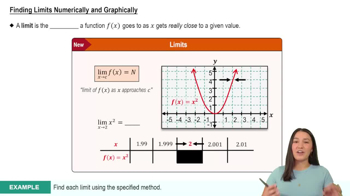
The limit of a function f(x) as x approaches a value c is the value that f(x) gets closer to as x gets closer to c.
진행 상황 추적
컨트롤 버튼이 '내비게이션' 모드로 변경되었습니다.
1/20
추천 영상
03:33
Cases Where Limits Do Not Exist Example 2
3140
views
84
rank
6:47
Finding Limits Numerically and Graphically
9586
views
355
rank
3
comments
03:07
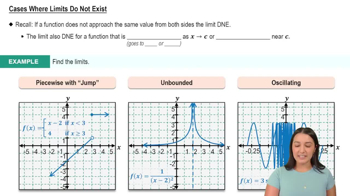
Cases Where Limits Do Not Exist
3450
views
80
rank
1
comments
이 집합의 용어 (20)
하이드의 정의
What is the definition of a limit in calculus?
The limit of a function f(x) as x approaches a value c is the value that f(x) gets closer to as x gets closer to c.
How is the limit of f(x) as x approaches c written symbolically?
It is written as \(\lim_{x \to c} f(x)\).
What does it mean if \(\lim_{x \to c} f(x) = L\)?
It means as x approaches c, the values of f(x) approach the number L.
What is a one-sided limit?
A one-sided limit considers the value of f(x) as x approaches c from only one side: left (\(x \to c^-\)) or right (\(x \to c^+\)).
When does a limit not exist?
A limit does not exist if the left and right limits are not equal, or if the function grows without bound near c.
What is the limit of a constant function f(x) = k as x approaches any value c?
The limit is k, since the function value is always k.
How do you find the limit of a polynomial function as x approaches c?
Substitute x = c directly into the polynomial to find the limit.
What is the limit of \(\frac{1}{x}\) as x approaches 0 from the right?
The limit is +∞ because values become very large positive numbers.
What is the limit of \(\frac{1}{x}\) as x approaches 0 from the left?
The limit is -∞ because values become very large negative numbers.
What is the Squeeze Theorem?
If f(x) ≤ g(x) ≤ h(x) near c and \(\lim_{x \to c} f(x) = \lim_{x \to c} h(x) = L\), then \(\lim_{x \to c} g(x) = L\).
What is an indeterminate form in limits?
An expression like \(\frac{0}{0}\) or \(\infty - \infty\) that does not directly determine the limit.
How can limits involving indeterminate forms be evaluated?
By algebraic manipulation, factoring, rationalizing, or applying L'Hôpital's Rule if applicable.
What is the limit of \(\sin x / x\) as x approaches 0?
The limit is 1.
What is the limit of \((1 + \frac{1}{n})^n\) as n approaches infinity?
The limit is the mathematical constant e, approximately 2.718.
What does it mean for a function to be continuous at a point c in terms of limits?
f is continuous at c if \(\lim_{x \to c} f(x) = f(c)\).
What is the limit of \(x^2\) as x approaches 3?
The limit is 9, since \(3^2 = 9\).
How do you interpret \(\lim_{x \to \infty} f(x)\)?
It describes the behavior of f(x) as x grows without bound.
What is the limit of \(\frac{1}{x}\) as x approaches infinity?
The limit is 0.
What is the limit of \(\frac{1}{x}\) as x approaches negative infinity?
The limit is 0.
What is the difference between a limit and a function value?
A limit describes the value f(x) approaches near c, while the function value is f(c) itself.
 뒤로
뒤로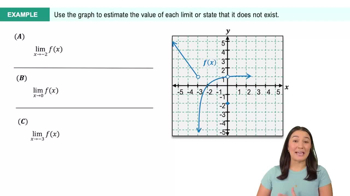
 03:33
03:33