Skip to main content
Calculus
나의 코스
배우기
시험 준비
AI 튜터
학습 가이드
교과서적 해결책
플래시카드
탐험해 보세요
앱을 사용해 보세요
나의 코스
배우기
시험 준비
AI 튜터
학습 가이드
교과서적 해결책
플래시카드
탐험해 보세요
앱을 사용해 보세요
뒤로
Exponential Functions and Their Derivatives
카드를 뒤집기 위해 탭할 수 있습니다.
What is the general form of an exponential function?
카드를 뒤집기 위해 탭할 수 있습니다.
👆
What is the general form of an exponential function?
An exponential function has the form \(f(x)=a^x\), where
a
is a positive constant not equal to 1.
진행 상황 추적
컨트롤 버튼이 '내비게이션' 모드로 변경되었습니다.
1/20
추천 영상
4:46
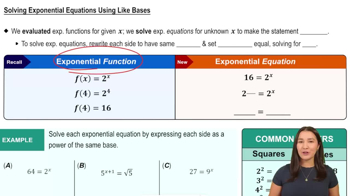
Solving Exponential Equations Using Like Bases
1231
views
12
rank
5:02
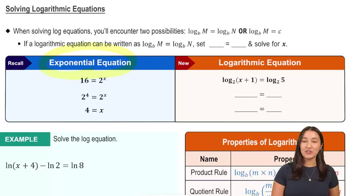
Solving Logarithmic Equations
990
views
7
rank
5:47
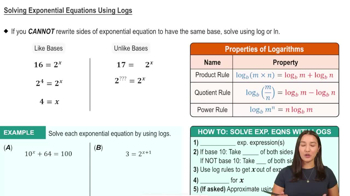
Solving Exponential Equations Using Logs
1034
views
8
rank
이 집합의 용어 (20)
하이드의 정의
What is the general form of an exponential function?
An exponential function has the form \(f(x)=a^x\), where
a
is a positive constant not equal to 1.
What is the base of the natural exponential function?
The base of the natural exponential function is
e
, approximately equal to 2.71828.
Write the natural exponential function.
The natural exponential function is \(f(x)=e^x\).
What is the derivative of \(e^x\)?
The derivative of \(e^x\) is \(e^x\).
What is the derivative of \(a^x\) where
a
is a positive constant?
The derivative is \(a^x \ln(a)\).
How do you differentiate \(e^{g(x)}\) where
g(x)
is a function of
x
?
Use the chain rule: derivative is \(e^{g(x)} g'(x)\).
What is the derivative of \(a^{g(x)}\) where
a
is constant and
g(x)
is a function?
The derivative is \(a^{g(x)} \ln(a) g'(x)\).
Why is the function \(e^x\) unique among exponential functions?
Because its derivative is the same as the function itself: \(\frac{d}{dx} e^x = e^x\).
What is the natural logarithm function in relation to the exponential function?
The natural logarithm \(\ln(x)\) is the inverse of the natural exponential function \(e^x\).
How can you rewrite \(a^x\) using the natural exponential function?
It can be rewritten as \(a^x = e^{x \ln(a)}\).
What is the derivative of \(\ln(x)\) for
x > 0
?
The derivative is \(\frac{1}{x}\).
How do you differentiate a function of the form \(e^{kx}\) where
k
is a constant?
The derivative is \(k e^{kx}\).
What is the significance of the constant
e
in calculus?
e
is the unique base for which the exponential function's rate of change equals the function itself.
How do you apply the chain rule to differentiate \(a^{u(x)}\)?
The derivative is \(a^{u(x)} \ln(a) u'(x)\).
What is the derivative of \(e^{2x}\)?
The derivative is \(2 e^{2x}\).
If \(f(x) = 3^x\), what is \(f'(x)\)?
The derivative is \(3^x \ln(3)\).
What rule is essential for differentiating composite exponential functions?
The
chain rule
is essential.
How do you express the derivative of \(e^{x^2}\)?
The derivative is \(2x e^{x^2}\).
What is the derivative of \(a^{x+c}\) where
c
is a constant?
The derivative is \(a^{x+c} \ln(a)\).
How does the derivative of exponential functions compare to polynomial functions?
Exponential function derivatives are proportional to the original function, unlike polynomials whose derivatives reduce degree.
 뒤로뒤로
 4:46