Skip to main content
Calculus
나의 코스
배우기
시험 준비
AI 튜터
학습 가이드
교과서적 해결책
플래시카드
탐험해 보세요
앱을 사용해 보세요
나의 코스
배우기
시험 준비
AI 튜터
학습 가이드
교과서적 해결책
플래시카드
탐험해 보세요
앱을 사용해 보세요
뒤로
Infinite Sequences and Series - Calculus
카드를 뒤집기 위해 탭할 수 있습니다.
What is a sequence in calculus?
카드를 뒤집기 위해 탭할 수 있습니다.
👆
What is a sequence in calculus?
A
sequence
is a function whose domain is the set of natural numbers, written as {a1, a2, a3, ..., an, ...}, where an is the nth term.
진행 상황 추적
컨트롤 버튼이 '내비게이션' 모드로 변경되었습니다.
1/26
추천 영상
VideoThumbView.guidedCourse
5:59
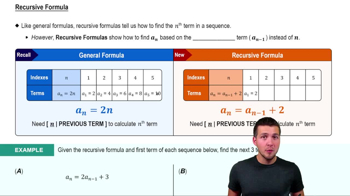
Recursive Formulas
858
views
32
rank
VideoThumbView.guidedCourse
7:00
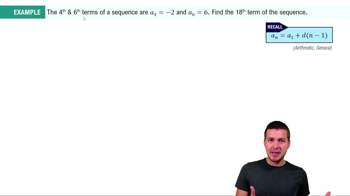
Arithmetic Sequences - General Formula Example 2
482
views
15
rank
VideoThumbView.guidedCourse
04:18
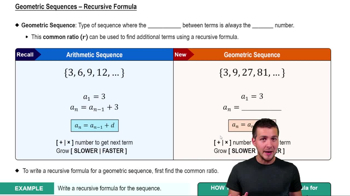
Geometric Sequences - Recursive Formula
635
views
15
rank
이 집합의 용어 (26)
하이드의 정의
What is a sequence in calculus?
A
sequence
is a function whose domain is the set of natural numbers, written as {a1, a2, a3, ..., an, ...}, where an is the nth term.
How is the convergence of a sequence defined?
A sequence {an}
converges
to L if for every positive number ε, there exists an integer N such that for all n > N, |an - L| < ε.
What does it mean for a sequence to diverge to infinity?
A sequence {an}
diverges to infinity
if for every number M, there exists an integer N such that for all n > N, an > M.
State the Sum Rule for limits of sequences.
If lim an = A and lim bn = B, then lim (an + bn) = A + B.
What is the Sandwich Theorem for sequences?
If an ≤ bn ≤ cn for all n beyond some index and lim an = lim cn = L, then lim bn = L.
Define a monotonic sequence.
A sequence is
monotonic
if it is either nondecreasing (an ≤ an+1) or nonincreasing (an ≥ an+1) for all n.
What is the Monotonic Sequence Theorem?
If a sequence is both bounded and monotonic, then it
converges
.
What is an infinite series?
An
infinite series
is the sum of the terms of a sequence: a1 + a2 + a3 + ... + an + ... .
When does a geometric series converge?
A geometric series with ratio r converges if |r| < 1, and its sum is a/(1 - r). It diverges if |r| ≥ 1.
State the nth-Term Test for Divergence.
If lim an ≠ 0 or does not exist, then the series Σ an
diverges
.
What is the Integral Test for series convergence?
If f(x) is continuous, positive, decreasing for x ≥ 1 and an = f(n), then Σ an and ∫ f(x) dx both converge or both diverge.
State the p-series convergence criteria.
The p-series Σ 1/n^p converges if p > 1 and diverges if p ≤ 1.
What is the Comparison Test for series?
If 0 ≤ an ≤ bn for all n beyond some N, then if Σ bn converges, Σ an converges; if Σ an diverges, Σ bn diverges.
Explain the Limit Comparison Test.
If lim (an/bn) = c > 0 and Σ bn converges or diverges, then Σ an also converges or diverges respectively.
State the Ratio Test for series convergence.
If lim |a(n+1)/an| = ρ, then the series converges if ρ < 1, diverges if ρ > 1, and is inconclusive if ρ = 1.
State the Root Test for series convergence.
If lim n-th root of |an| = ρ, then the series converges if ρ < 1, diverges if ρ > 1, and is inconclusive if ρ = 1.
What is an alternating series?
An
alternating series
is a series whose terms alternate in sign, e.g., Σ (-1)^(n+1) un.
State the Alternating Series Test (Leibniz's Test).
An alternating series converges if the terms un are positive, decreasing, and lim un = 0.
What is absolute convergence of a series?
A series Σ an converges
absolutely
if the series of absolute values Σ |an| converges.
What is conditional convergence?
A series converges
conditionally
if Σ an converges but Σ |an| diverges.
What is a power series?
A
power series
is a series of the form Σ cn (x - a)^n, where cn are coefficients and a is the center.
Define radius and interval of convergence for power series.
The
radius of convergence
R is the distance from a where the series converges; the
interval of convergence
is all x with |x - a| < R.
What is the Taylor series of a function f(x) centered at a?
The Taylor series is Σ (f^n(a)/n!) (x - a)^n, where f^n(a) is the nth derivative of f at a.
What is the Maclaurin series?
The Maclaurin series is the Taylor series centered at a = 0.
State the Remainder Estimation Theorem for Taylor series.
The remainder Rn(x) satisfies |Rn(x)| ≤ M |x - a|^(n+1) / (n+1)!, where M bounds the (n+1)th derivative on the interval.
What is the Binomial Series?
The Binomial series expands (1 + x)^k as Σ (k choose n) x^n for any real k.
 뒤로뒤로
 5:59