
교과서 질문
Suppose the sequence { aₙ} is defined by the explicit formula aₙ = 1/n, for n=1, 2, 3, .....Write out the first five terms of the sequence.
58
views
 검증된 단계별 안내

 05:35

 07:15
 07:51
Suppose the sequence { aₙ} is defined by the explicit formula aₙ = 1/n, for n=1, 2, 3, .....Write out the first five terms of the sequence.
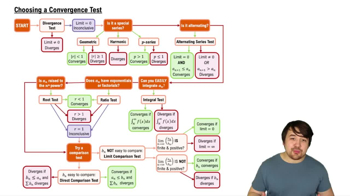
11–86. Applying convergence tests Determine whether the following series converge. Justify your answers.
∑ (from k = 1 to ∞)(cos(1 / k) – cos(1 / (k + 1)))
43–44. Periodic doses
Suppose you take a dose of m mg of a particular medication once per day. Assume f equals the fraction of the medication that remains in your blood one day later. Just after taking another dose of medication on the second day, the amount of medication in your blood equals the sum of the second dose and the fraction of the first dose remaining in your blood, which is m + mf. Continuing in this fashion, the amount of medication in your blood just after your nth dose is
Aₙ = m + mf + ⋯ + mfⁿ⁻¹.
For the given values of f and m, calculate A₅, A₁₀, A₃₀, and lim (n → ∞) Aₙ. Interpret the meaning of the limit lim (n → ∞) Aₙ.
43.f = 0.25,m = 200 mg
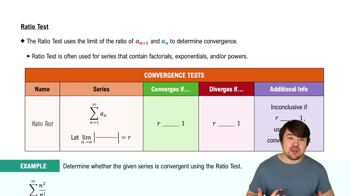
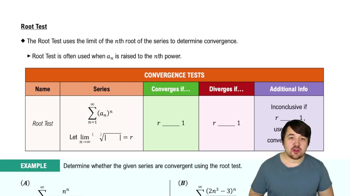
11–86. Applying convergence tests Determine whether the following series converge. Justify your answers.
∑ (from k = 1 to ∞) 2⁹k / kᵏ
11–86. Applying convergence tests Determine whether the following series converge. Justify your answers.
∑ (from k = 1 to ∞)(1 / √(k + 2) – 1 / √k)
Evaluate 1000!/998! without a calculator.