Finding steady states using infinite series Solve Exercise 40 by expressing the amount of aspirin in your blood as a geometric series and evaluating the series.
Ch. 10 - Sequences and Infinite Series
10장, 문제 10.R.91
Estimate the value of the series ∑ (from k = 1 to ∞)1 / (2k + 5)³ to within 10⁻⁴ of its exact value.
검증된 단계별 안내1
Recognize that the series \( \sum_{k=1}^{\infty} \frac{1}{(2k+5)^3} \) is a positive, decreasing series with terms of the form \( a_k = \frac{1}{(2k+5)^3} \). Since the terms decrease and are positive, we can use the Integral Test remainder estimate to approximate the error when truncating the series.
To estimate the sum within an error of \( 10^{-4} \), first decide how many terms \( N \) to sum. The remainder \( R_N = \sum_{k=N+1}^{\infty} \frac{1}{(2k+5)^3} \) can be bounded by an integral: \[ R_N \leq \int_{N}^{\infty} \frac{1}{(2x+5)^3} \, dx. \]
Evaluate the integral \( \int_{N}^{\infty} \frac{1}{(2x+5)^3} \, dx \) by substitution. Let \( u = 2x + 5 \), so \( du = 2 \, dx \) or \( dx = \frac{du}{2} \). Change the limits accordingly and integrate \( \int \frac{1}{u^3} \cdot \frac{du}{2} \).
After integrating, express the remainder bound \( R_N \) in terms of \( N \). Set this bound less than or equal to \( 10^{-4} \) and solve for \( N \) to find the minimum number of terms needed to guarantee the desired accuracy.
Finally, sum the first \( N \) terms of the series \( \sum_{k=1}^{N} \frac{1}{(2k+5)^3} \) to get an approximation of the infinite series within \( 10^{-4} \) of the exact value.

비슷한 문제에 대한 검증된 영상 답변:
이 영상 해법은 위 문제에 도움이 된다고 튜터들이 추천한 것입니다.
영상 길이:
6m주요 개념
질문에 올바르게 답하기 위해 반드시 이해해야 하는 핵심 개념들은 다음과 같습니다.
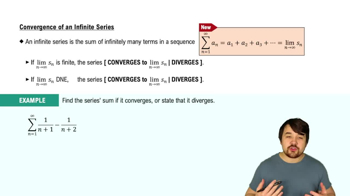
Infinite Series and Convergence
An infinite series is the sum of infinitely many terms. To work with such series, it is crucial to determine if they converge to a finite value. For series with positive terms decreasing to zero, convergence can often be tested using comparison or integral tests.
추천 영상:
가이드 코스
Convergence of an Infinite Series
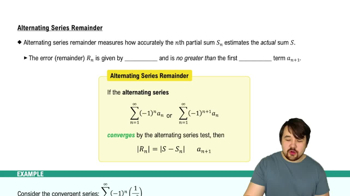
Remainder Estimation for Series
When approximating an infinite series by partial sums, the remainder (or error) is the difference between the exact sum and the partial sum. Estimating this remainder helps ensure the approximation is within a desired accuracy, often using integral bounds or known inequalities.
추천 영상:
가이드 코스
Alternating Series Remainder
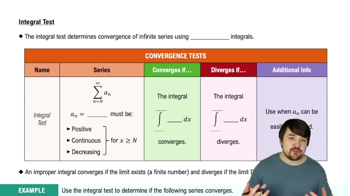
Integral Test and Integral Bounds
The integral test relates a series to an improper integral to determine convergence and estimate remainders. For a decreasing positive function, the remainder after n terms can be bounded by integrals of the function from n to infinity, providing a practical way to estimate errors.
추천 영상:
가이드 코스
Integral Test
관련 실천
교과서 질문
53
views
교과서 질문
42–76. Convergence or divergence Use a convergence test of your choice to determine whether the following series converge.
∑ (from k = 1 to ∞)5ᵏ / 2²ᵏ⁺¹
42
views
교과서 질문
Geometric sums
Evaluate the geometric sums
∑ (from k = 0 to 9) (0.2)ᵏand∑ (from k = 2 to 9) (0.2)ᵏ.
50
views
교과서 질문
Explain why or why not
Determine whether the following statements are true and give an explanation or counterexample.
a.The terms of the sequence {aₙ} increase in magnitude, so the limit of the sequence does not exist.
43
views
교과서 질문
12–24. Limits of sequences Evaluate the limit of the sequence or state that it does not exist.
aₙ = (2ⁿ + 5ⁿ⁺¹) / 5ⁿ
39
views
교과서 질문
b.Does the series ∑ (from k = 1 to ∞) k/(k + 1) converge? Why or why not?
86
views