Ch. 10 - Sequences and Infinite Series
Briggs - Calculus: Early Transcendentals 3rd Edition
Briggs3rd EditionCalculus: Early TranscendentalsISBN: 9780136847243당신이 사용하는 게 아니라요?교과서 변경
10장, 문제 10.3.5a

Find the first term a and the ratio r of each geometric series.


a. ∑ k = 0 to ∞(2/3) × (1/5)ᵏ

검증된 단계별 안내
1
Identify the general form of a geometric series, which is given by the sum from k = 0 to infinity of \( a \times r^k \), where \( a \) is the first term and \( r \) is the common ratio.
Compare the given series \( \sum_{k=0}^\infty \left( \frac{2}{3} \times \left( \frac{1}{5} \right)^k \right) \) to the general form to determine the first term \( a \) and the ratio \( r \).
Note that the first term \( a \) corresponds to the term when \( k = 0 \), which is \( \frac{2}{3} \times \left( \frac{1}{5} \right)^0 = \frac{2}{3} \times 1 = \frac{2}{3} \).
Identify the common ratio \( r \) as the factor raised to the power \( k \), which is \( \frac{1}{5} \).
Summarize that the first term \( a = \frac{2}{3} \) and the common ratio \( r = \frac{1}{5} \).

비슷한 문제에 대한 검증된 영상 답변:

이 영상 해법은 위 문제에 도움이 된다고 튜터들이 추천한 것입니다.
영상 길이:
1m

주요 개념

질문에 올바르게 답하기 위해 반드시 이해해야 하는 핵심 개념들은 다음과 같습니다.

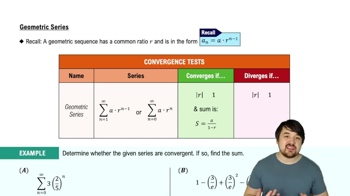
Geometric Series Definition

A geometric series is a sum of terms where each term after the first is found by multiplying the previous term by a constant ratio r. It can be written as a + ar + ar² + ar³ + ... , where a is the first term and r is the common ratio.
추천 영상:
가이드 코스
06:00
Geometric Series

Identifying the First Term (a)

The first term a of a geometric series is the initial term when the index k is zero. In the series ∑ from k=0 to ∞ of a × r^k, the first term is simply the coefficient multiplied by r raised to the zero power, which equals a.
추천 영상:
05:00
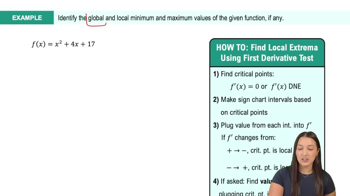
The First Derivative Test: Finding Local Extrema Example 4

Common Ratio (r)

The common ratio r is the factor by which each term is multiplied to get the next term. It is the base of the exponent k in the series expression a × r^k, and it determines the behavior and convergence of the series.
추천 영상:
가이드 코스
5:57
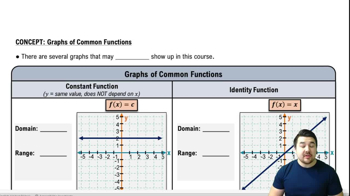
Graphs of Common Functions
관련 실천
교과서 질문

18–20. Evaluating geometric series two ways Evaluate each geometric series two ways.


a. Find the nth partial sum Sₙ of the series and evaluate lim (as n → ∞) Sₙ.


∑ (k = 0 to ∞) (–2/7)ᵏ

60
views

교과서 질문

41–44. {Use of Tech} Remainders and estimates Consider the following convergent series.


a. Find an upper bound for the remainder in terms of n.


43. ∑ (k = 1 to ∞) 1 / 3ᵏ

154
views
교과서 질문

67–70. Formulas for sequences of partial sums Consider the following infinite series.


a.Find the first four partial sums S₁, S₂, S₃, S₄ of the series.


∑⁽∞⁾ₖ₌₁2⁄[(2k − 1)(2k + 1)]

89
views
교과서 질문

39–40. {Use of Tech} Lower and upper bounds of a series

For each convergent series and given value of n, use Theorem 10.13 to complete the following.


a. Use Sₙ to estimate the sum of the series.


39. ∑ (k = 1 to ∞) 1 / k⁷ ; n = 2

91
views
교과서 질문

72–75. {Use of Tech} Practical sequences

Consider the following situations that generate a sequence


b.Find an explicit formula for the terms of the sequence.


Drug elimination

Jack took a 200-mg dose of a pain killer at midnight. Every hour, 5% of the drug is washed out of his bloodstream. Let dₙ be the amount of drug in Jack’s blood n hours after the drug was taken, where d₀ = 200mg.

48
views
교과서 질문

{Use of Tech} Periodic dosing

Many people take aspirin on a regular basis as a preventive measure for heart disease. Suppose a person takes 80 mg of aspirin every 24 hours. Assume aspirin has a half-life of 24 hours; that is, every 24 hours, half of the drug in the blood is eliminated.


a.Find a recurrence relation for the sequence {dₙ} that gives the amount of drug in the blood after the nᵗʰ dose, where d₁ = 80.

44
views