Explain why the magnitude of the remainder in an alternating series (with terms that are nonincreasing in magnitude) is less than or equal to the magnitude of the first neglected term.
Ch. 10 - Sequences and Infinite Series
10장, 문제 10.2.77
Growth rates of sequences
Use Theorem 10.6 to find the limit of the following sequences or state that they diverge.
{n¹⁰ / ln20n}
검증된 단계별 안내1
Identify the sequence given: \(a_n = \frac{n^{10}}{\ln(20n)}\).
Recall Theorem 10.6, which typically deals with growth rates of sequences involving polynomials and logarithmic functions. It states that polynomial functions grow faster than logarithmic functions as \(n \to \infty\).
Analyze the numerator and denominator separately: the numerator \(n^{10}\) grows very quickly (polynomial growth), while the denominator \(\ln(20n)\) grows slowly (logarithmic growth).
Since the numerator grows much faster than the denominator, the fraction \(\frac{n^{10}}{\ln(20n)}\) increases without bound as \(n\) becomes very large.
Conclude that the limit of the sequence \(a_n\) as \(n \to \infty\) is \(+\infty\), meaning the sequence diverges to infinity.

비슷한 문제에 대한 검증된 영상 답변:
이 영상 해법은 위 문제에 도움이 된다고 튜터들이 추천한 것입니다.
영상 길이:
1m주요 개념
질문에 올바르게 답하기 위해 반드시 이해해야 하는 핵심 개념들은 다음과 같습니다.
Limits of Sequences
The limit of a sequence describes the value that the terms approach as the index goes to infinity. Understanding how to evaluate limits helps determine whether a sequence converges to a finite number or diverges to infinity or does not settle.
추천 영상:
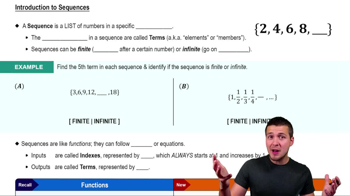
Introduction to Sequences
Growth Rates of Functions
Comparing growth rates involves analyzing how fast functions like polynomials, logarithms, and exponentials increase as their input grows. Polynomials grow faster than logarithmic functions, which is crucial for determining the behavior of sequences involving these terms.
추천 영상:
가이드 코스
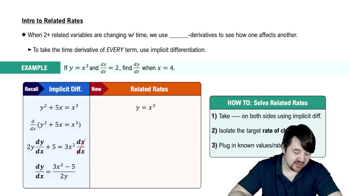
Intro To Related Rates
Theorem 10.6 (Comparison of Growth Rates)
Theorem 10.6 typically states that for large n, polynomial functions dominate logarithmic functions, meaning n^k grows faster than ln(n) for any positive integer k. This theorem helps conclude that sequences with polynomial numerators and logarithmic denominators tend to infinity.
추천 영상:
가이드 코스
Intro To Related Rates
관련 실천
교과서 질문
86
views
교과서 질문
21–42. Geometric series Evaluate each geometric series or state that it diverges.
41.∑ (k = 1 to ∞) 4 / 12ᵏ
42
views
교과서 질문
What comparison series would you use with the Limit Comparison Test to determine whether ∑ (k = 1 to ∞) (k² + k + 5) / (k³ + 3k + 1) converges?
59
views
교과서 질문
49–50. Limits from graphs Consider the following sequences. Find the first four terms of the sequence .Based on part (a) and the figure, determine a plausible limit of the sequence.
aₙ = 2 + 2⁻ⁿ;n = 1, 2, 3, …
56
views
교과서 질문
11–86. Applying convergence tests Determine whether the following series converge. Justify your answers.
∑ (from k = 1 to ∞) k⁴ / (eᵏ⁵)
66
views
교과서 질문
13–52. Limits of sequences
Find the limit of the following sequences or determine that the sequence diverges.
{ⁿ√(e³ⁿ⁺⁴)}
34
views