Ch. 11 - Power Series
Briggs - Calculus: Early Transcendentals 3rd Edition
Briggs3rd EditionCalculus: Early TranscendentalsISBN: 9780136847243당신이 사용하는 게 아니라요?교과서 변경
11장, 문제 11.4.83

L'Hôpital's Rule by Taylor series Suppose f and g have Taylor series about the point a.
a. If f(a) = g(a) = 0 and g′(a) ≠ 0, evaluate lim ₓ→ₐ f(x)/g(x) by expanding f and g in their Taylor series. Show that the result is consistent withl’Hôpital’s Rule.
b. If f(a) = g(a) =f′(a) = g′(a) = 0 and g′′(a) ≠ 0, evaluate lim ₓ→ₐ f(x)/g(x) by expanding f and g in their Taylor series. Show that the result is consistent with two applications of 1'Hôpital's Rule.

검증된 단계별 안내
1
Step 1: Recall the Taylor series expansions of functions \(f\) and \(g\) about the point \(a\). For a function \(h\), the expansion is: \[ \displaystyle h(x) = h(a) + h'(a)(x - a) + \frac{h''(a)}{2!}(x - a)^2 + \cdots \] We will use this to expand both \(f(x)\) and \(g(x)\).
Step 2: For part (a), since \(f(a) = g(a) = 0\) and \(g'(a) \neq 0\), write the expansions: \[ \begin{aligned} f(x) &= f(a) + f'(a)(x - a) + \cdots = f'(a)(x - a) + \cdots \\ g(x) &= g(a) + g'(a)(x - a) + \cdots = g'(a)(x - a) + \cdots \end{aligned} \] Ignore higher order terms as \(x \to a\).
Step 3: Form the ratio \(\frac{f(x)}{g(x)}\) near \(x = a\): \[ \frac{f(x)}{g(x)} \approx \frac{f'(a)(x - a)}{g'(a)(x - a)} = \frac{f'(a)}{g'(a)} \] This shows the limit is \(\lim_{x \to a} \frac{f(x)}{g(x)} = \frac{f'(a)}{g'(a)}\), consistent with L'Hôpital's Rule applied once.
Step 4: For part (b), given \(f(a) = g(a) = f'(a) = g'(a) = 0\) and \(g''(a) \neq 0\), write the expansions including second derivatives: \[ \begin{aligned} f(x) &= f(a) + f'(a)(x - a) + \frac{f''(a)}{2}(x - a)^2 + \cdots = \frac{f''(a)}{2}(x - a)^2 + \cdots \\ g(x) &= g(a) + g'(a)(x - a) + \frac{g''(a)}{2}(x - a)^2 + \cdots = \frac{g''(a)}{2}(x - a)^2 + \cdots \end{aligned} \]
Step 5: Form the ratio near \(x = a\): \[ \frac{f(x)}{g(x)} \approx \frac{\frac{f''(a)}{2}(x - a)^2}{\frac{g''(a)}{2}(x - a)^2} = \frac{f''(a)}{g''(a)} \] This matches the result of applying L'Hôpital's Rule twice, since the first derivatives vanish and the second derivatives determine the limit.

비슷한 문제에 대한 검증된 영상 답변:

이 영상 해법은 위 문제에 도움이 된다고 튜터들이 추천한 것입니다.
영상 길이:
3m

주요 개념

질문에 올바르게 답하기 위해 반드시 이해해야 하는 핵심 개념들은 다음과 같습니다.

Taylor Series Expansion

A Taylor series represents a function as an infinite sum of terms calculated from the derivatives at a single point. It approximates functions near that point, allowing us to express f(x) and g(x) as polynomials around a. This expansion is crucial for analyzing limits by comparing the leading terms of f and g.
추천 영상:
08:42
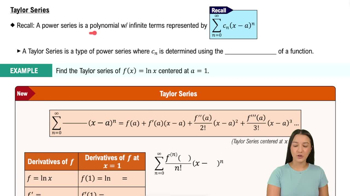
Taylor Series

L'Hôpital's Rule

L'Hôpital's Rule helps evaluate limits of indeterminate forms like 0/0 by differentiating numerator and denominator. If f(a) = g(a) = 0 and g'(a) ≠ 0, the limit of f(x)/g(x) as x approaches a equals f'(a)/g'(a). This rule can be applied repeatedly if higher-order derivatives vanish.
추천 영상:
5:50
Power Rules

Relationship Between Taylor Series and L'Hôpital's Rule

By expanding f and g into Taylor series, the leading nonzero terms determine the limit of f(x)/g(x). This approach shows that the ratio of the first nonzero derivatives matches the result from L'Hôpital's Rule, providing a series-based justification for the rule and its repeated application.
추천 영상:
08:42
Taylor Series