Ch. 11 - Power Series
Briggs - Calculus: Early Transcendentals 3rd Edition
Briggs3rd EditionCalculus: Early TranscendentalsISBN: 9780136847243당신이 사용하는 게 아니라요?교과서 변경
11장, 문제 11.1.5

Suppose f(0)=1, f'(0)=0, f''(0)=2, and f⁽³⁾(0)=6. Find the third-order Taylor polynomial for f centered at 0 and use it to approximate f(0.2).

검증된 단계별 안내
1
Recall the formula for the third-order Taylor polynomial of a function \( f \) centered at \( a = 0 \): \[ P_3(x) = f(0) + f'(0) x + \frac{f''(0)}{2!} x^2 + \frac{f^{(3)}(0)}{3!} x^3 \]
Substitute the given values into the polynomial: \[ f(0) = 1, \quad f'(0) = 0, \quad f''(0) = 2, \quad f^{(3)}(0) = 6 \] So, \[ P_3(x) = 1 + 0 \cdot x + \frac{2}{2} x^2 + \frac{6}{6} x^3 \]
Simplify the coefficients in the polynomial: \[ P_3(x) = 1 + x^2 + x^3 \]
To approximate \( f(0.2) \), substitute \( x = 0.2 \) into the polynomial: \[ P_3(0.2) = 1 + (0.2)^2 + (0.2)^3 \]
Calculate the powers of \( 0.2 \) (without final summation) to prepare for approximation: \[ (0.2)^2 = 0.04, \quad (0.2)^3 = 0.008 \] Then, sum these terms with 1 to get the approximate value of \( f(0.2) \).

비슷한 문제에 대한 검증된 영상 답변:

이 영상 해법은 위 문제에 도움이 된다고 튜터들이 추천한 것입니다.
영상 길이:
3m

주요 개념

질문에 올바르게 답하기 위해 반드시 이해해야 하는 핵심 개념들은 다음과 같습니다.

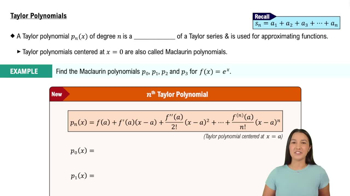
Taylor Polynomial

A Taylor polynomial approximates a function near a specific point using derivatives at that point. The nth-order Taylor polynomial includes terms up to the nth derivative, providing a polynomial that closely matches the function's behavior near the center.
추천 영상:
07:00
Taylor Polynomials

Derivatives and Their Role in Taylor Series

Derivatives at the center point determine the coefficients of the Taylor polynomial. Each term involves the function's nth derivative evaluated at the center, divided by n! and multiplied by (x - center)^n, capturing the function's local rate of change.
추천 영상:
08:42
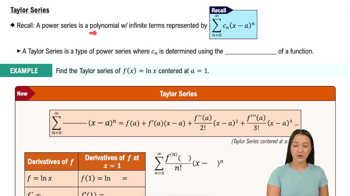
Taylor Series

Polynomial Approximation and Evaluation

Once the Taylor polynomial is constructed, it can be used to approximate function values near the center by substituting the desired x-value. This provides an estimate that becomes more accurate with higher-order polynomials and points closer to the center.
추천 영상:
07:00
Taylor Polynomials
관련 실천
교과서 질문

{Use of Tech} Newton's derivation of the sine and arcsine series Newton discovered the binomial series and then used it ingeniously to obtain many more results. Here is a case in point.

a. Referring to the figure, show that x = sin s or s = sin ⁻¹ x.

b. The area of a circular sector of radius r subtended by an angle θ is 1/2r²θ. Show that the area of the circular sector APE is s/2, which implies that

s = 2 ∫₀ˣ √(1 − t²) dt − x √(1 −x²)

c. Use the binomial series for f(x) = √(1 − x²) to obtain the first few terms of the Taylor series for s=sin ⁻¹ x.

d. Newton next inverted the series in part (c) to obtain the Taylor series for x=sin s. He did this by assuming sin s = ∑ aₖ sᵏ and solving x = sin(sin ⁻¹ x) for the coefficients aₖ. Find the first few terms of the Taylor series for sin s using this idea (a computer algebra system might be helpful as well).

124
views
교과서 질문

Limits Evaluate the following limits using Taylor series.

lim ₓ→∞ x(e¹/ˣ − 1)

85
views
교과서 질문

Power series for derivatives


a. Differentiate the Taylor series centered at 0 for the following functions.

b. Identify the function represented by the differentiated series.

c. Give the interval of convergence of the power series for the derivative.


f(x) = (1 − x)⁻¹

61
views
교과서 질문

Approximating real numbers Use an appropriate Taylor series to find the first four nonzero terms of an infinite series that is equal to the following numbers.

√e

68
views
교과서 질문

Does the accuracy of an approximation given by a Taylor polynomial generally increase or decrease with the order of the approximation? Explain.

84
views
교과서 질문

Limits Evaluate the following limits using Taylor series.

lim ₓ→₄ (x² 16)/(ln (x 3)}

75
views