
Ch. 11 - Power Series
Briggs - Calculus: Early Transcendentals 3rd Edition
Briggs3rd EditionCalculus: Early TranscendentalsISBN: 9780136847243당신이 사용하는 게 아니라요?교과서 변경
11장, 문제 11.3.27b

Taylor series


b. Write the power series using summation notation.


f(x)=sin x, a = π/2

검증된 단계별 안내
1
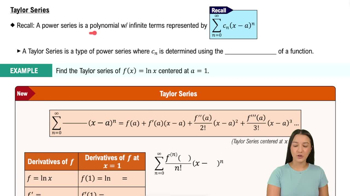
Recall the Taylor series formula for a function \( f(x) \) centered at \( a \): \[ f(x) = \sum_{n=0}^{\infty} \frac{f^{(n)}(a)}{n!} (x - a)^n \] where \( f^{(n)}(a) \) is the \( n \)-th derivative of \( f \) evaluated at \( a \).
Identify the function and center: here, \( f(x) = \sin x \) and \( a = \frac{\pi}{2} \). We need to find the derivatives of \( \sin x \) evaluated at \( x = \frac{\pi}{2} \).
Calculate the first few derivatives of \( \sin x \) and evaluate them at \( x = \frac{\pi}{2} \): - \( f(x) = \sin x \) - \( f'(x) = \cos x \) - \( f''(x) = -\sin x \) - \( f^{(3)}(x) = -\cos x \) - \( f^{(4)}(x) = \sin x \) Evaluate each at \( x = \frac{\pi}{2} \): - \( f\left(\frac{\pi}{2}\right) = 1 \) - \( f'\left(\frac{\pi}{2}\right) = 0 \) - \( f''\left(\frac{\pi}{2}\right) = -1 \) - \( f^{(3)}\left(\frac{\pi}{2}\right) = 0 \) - \( f^{(4)}\left(\frac{\pi}{2}\right) = 1 \)
Notice the pattern in the derivatives evaluated at \( a = \frac{\pi}{2} \): the values cycle through \( 1, 0, -1, 0, 1, \ldots \). This pattern will help simplify the summation.
Write the Taylor series in summation notation using the pattern found: \[ \sin x = \sum_{n=0}^{\infty} \frac{f^{(n)}\left(\frac{\pi}{2}\right)}{n!} (x - \frac{\pi}{2})^n \] Substitute the values of the derivatives into the summation to express the power series explicitly.

비슷한 문제에 대한 검증된 영상 답변:

이 영상 해법은 위 문제에 도움이 된다고 튜터들이 추천한 것입니다.
영상 길이:
4m

주요 개념

질문에 올바르게 답하기 위해 반드시 이해해야 하는 핵심 개념들은 다음과 같습니다.

Taylor Series Expansion

A Taylor series represents a function as an infinite sum of terms calculated from the derivatives of the function at a single point. For a function f(x) centered at a point a, it is expressed as f(x) = Σ (f⁽ⁿ⁾(a)/n!) (x - a)ⁿ, where n! is factorial and f⁽ⁿ⁾(a) is the nth derivative at a.
추천 영상:
08:42
Taylor Series

Derivatives of sin(x)

The derivatives of sin(x) follow a repeating cycle every four derivatives: sin(x), cos(x), -sin(x), -cos(x), then back to sin(x). Evaluating these derivatives at x = π/2 simplifies the coefficients in the Taylor series, as sin(π/2) = 1 and cos(π/2) = 0.
추천 영상:
04:56
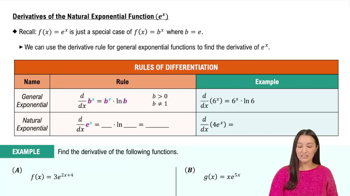
Derivative of the Natural Exponential Function (e^x)

Summation Notation for Power Series

Summation notation (Σ) compactly expresses infinite series by indicating the general term and the index of summation. Writing the Taylor series in summation form involves identifying the pattern of coefficients and powers of (x - a), allowing a concise representation of the entire series.
추천 영상:
05:58
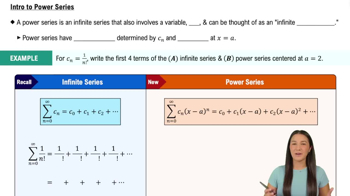
Intro to Power Series