Determine the end behavior of the following transcendental functions by analyzing appropriate limits. Then provide a simple sketch of the associated graph, showing asymptotes if they exist.
Ch. 2 - Limits
2장, 문제 2.4.49
Find all vertical asymptotes of the following functions. For each value of , determine , , and .
검증된 단계별 안내1
Identify the points where the denominator of the function f(x) = \(\frac{x+1}{x^3-4x^2+4x}\) is equal to zero, as these are potential vertical asymptotes. Set x^3 - 4x^2 + 4x = 0 and solve for x.
Factor the equation x^3 - 4x^2 + 4x = 0. Start by factoring out the greatest common factor, which is x, to get x(x^2 - 4x + 4) = 0.
Further factor the quadratic x^2 - 4x + 4. Notice that it is a perfect square trinomial, so it can be factored as (x - 2)^2. Thus, the equation becomes x(x - 2)^2 = 0.
Solve the factored equation x(x - 2)^2 = 0 to find the values of x that make the denominator zero. The solutions are x = 0 and x = 2.
For each potential vertical asymptote x = 0 and x = 2, evaluate the one-sided limits: \(\lim\)_{x \(\to\) a^+} f(x), \(\lim\)_{x \(\to\) a^-} f(x), and \(\lim\)_{x \(\to\) a} f(x). Analyze the behavior of the function as x approaches these values from the left and right to confirm the presence of vertical asymptotes.

비슷한 문제에 대한 검증된 영상 답변:
이 영상 해법은 위 문제에 도움이 된다고 튜터들이 추천한 것입니다.
영상 길이:
8m주요 개념
질문에 올바르게 답하기 위해 반드시 이해해야 하는 핵심 개념들은 다음과 같습니다.
Vertical Asymptotes
Vertical asymptotes occur in a function when the output approaches infinity as the input approaches a certain value. This typically happens when the denominator of a rational function equals zero while the numerator does not. Identifying vertical asymptotes involves finding the values of x that make the denominator zero and ensuring that the numerator is non-zero at those points.
추천 영상:
가이드 코스
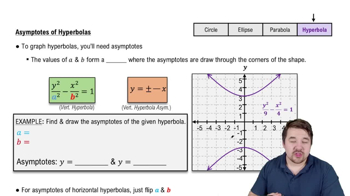
Asymptotes of Hyperbolas
Limits
Limits are fundamental in calculus, representing the value that a function approaches as the input approaches a certain point. In the context of vertical asymptotes, we evaluate the limits from both the left and right sides of the point of interest (denoted as a) to determine the behavior of the function near that point. If either limit approaches infinity, it indicates the presence of a vertical asymptote.
추천 영상:
One-Sided Limits
Rational Functions
Rational functions are expressions formed by the ratio of two polynomials. They are crucial in the study of vertical asymptotes because the behavior of these functions is heavily influenced by their numerator and denominator. Understanding how to factor and simplify rational functions helps in identifying points where the function may be undefined, leading to potential vertical asymptotes.
추천 영상:
Intro to Rational Functions
관련 실천
교과서 질문
350
views
교과서 질문
Use the definitions given in Exercise 57 to prove the following infinite limits.
lim x→1^+ 1 /1 − x=−∞
297
views
교과서 질문
Find the following limits or state that they do not exist. Assume a, b , c, and k are fixed real numbers.
lim x→3 −5x / √4x − 3
237
views
교과서 질문
Use the precise definition of a limit to prove the following limits. Specify a relationship between ε and δ that guarantees the limit exists.
lim x→7 f(x)=9, where f(x)={3x−12 if x≤7
x+2 if x>7
365
views
교과서 질문
Determine the end behavior of the following transcendental functions by analyzing appropriate limits. Then provide a simple sketch of the associated graph, showing asymptotes if they exist.
319
views
교과서 질문
Let f(x) =x^2−2x+3.
a. For ε=0.25, find the largest value of δ>0 satisfying the statement
|f(x)−2|<ε whenever 0<|x−1|<δ.
373
views