Consider the position function s(t) =−16t^2+100t representing the position of an object moving vertically along a line. Sketch a graph of s with the secant line passing through (0.5, s(0.5)) and (2, s(2)). Determine the slope of the secant line and explain its relationship to the moving object.
Ch. 2 - Limits
2장, 문제 2.4.65
Use analytical methods and/or a graphing utility to identify the vertical asymptotes (if any) of the following functions.
f(x)=1/ √x sec x
검증된 단계별 안내1
Step 1: Identify the domain of the function. The function f(x) = \( \frac{1}{\sqrt{x} \sec x} \) is defined where both \( \sqrt{x} \) and \( \sec x \) are defined and non-zero. \( \sqrt{x} \) is defined for \( x > 0 \), and \( \sec x = \frac{1}{\cos x} \) is defined where \( \cos x \neq 0 \).
Step 2: Determine where \( \sec x \) is undefined. The secant function, \( \sec x \), is undefined where \( \cos x = 0 \). This occurs at \( x = \frac{\pi}{2} + n\pi \), where \( n \) is an integer.
Step 3: Analyze the behavior of the function near the points where \( \sec x \) is undefined. As \( x \) approaches \( \frac{\pi}{2} + n\pi \), \( \cos x \) approaches 0, causing \( \sec x \) to approach infinity or negative infinity, leading to potential vertical asymptotes.
Step 4: Consider the behavior of \( \sqrt{x} \) as \( x \to 0^+ \). As \( x \to 0^+ \), \( \sqrt{x} \to 0^+ \), which causes the function \( f(x) \) to approach infinity, indicating a potential vertical asymptote at \( x = 0 \).
Step 5: Conclude the locations of the vertical asymptotes. Based on the analysis, the vertical asymptotes occur at \( x = 0 \) and \( x = \frac{\pi}{2} + n\pi \) for integer values of \( n \).

비슷한 문제에 대한 검증된 영상 답변:
이 영상 해법은 위 문제에 도움이 된다고 튜터들이 추천한 것입니다.
영상 길이:
2m주요 개념
질문에 올바르게 답하기 위해 반드시 이해해야 하는 핵심 개념들은 다음과 같습니다.
Vertical Asymptotes
Vertical asymptotes occur in a function when the output approaches infinity as the input approaches a certain value. This typically happens when the function is undefined at that point, often due to division by zero. Identifying vertical asymptotes involves finding values of x that make the denominator zero while ensuring the numerator is not also zero at those points.
추천 영상:
가이드 코스
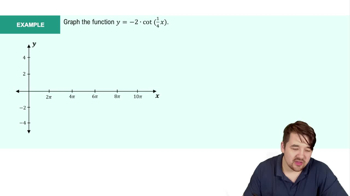
Introduction to Cotangent Graph Example 1
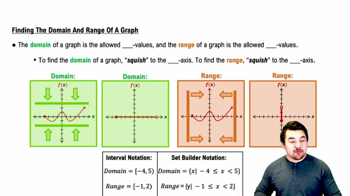
Domain of a Function
The domain of a function is the set of all possible input values (x-values) for which the function is defined. For the function f(x) = 1/√x sec x, the domain is restricted by the square root and the secant function. Understanding the domain is crucial for identifying vertical asymptotes, as any x-value that leads to an undefined function must be considered.
추천 영상:
가이드 코스
Finding the Domain and Range of a Graph
Graphing Utility
A graphing utility is a tool, often software or a calculator, that allows users to visualize functions and their behaviors. By plotting the function f(x) = 1/√x sec x, one can observe where the function approaches infinity, indicating vertical asymptotes. Graphing utilities can also help in analyzing the overall shape and trends of the function, providing insights that may not be immediately apparent through algebraic methods alone.
추천 영상:
가이드 코스
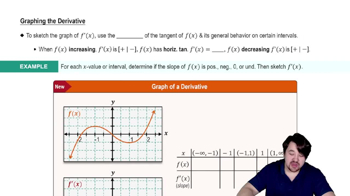
Graphing The Derivative
관련 실천
교과서 질문
370
views
교과서 질문
Evaluate each limit.
351
views
교과서 질문
Determine the interval(s) on which the following functions are continuous.
f(t)=t+2 / t^2−4
309
views
교과서 질문
A sequence is an infinite, ordered list of numbers that is often defined by a function. For example, the sequence {2,4,6,8,…} is specified by the function f(n) = 2n, where n=1,2,3,….The limit of such a sequence is lim n→∞ f(n), provided the limit exists. All the limit laws for limits at infinity may be applied to limits of sequences. Find the limit of the following sequences or state that the limit does not exist.
{0,1/2,2/3,3/4,…}, which is defined by f(n) = (n−1) / n, for n=1,2,3,…
453
views
교과서 질문
Use an appropriate limit definition to prove the following limits.
lim x→ 5x^2 − 25 / x − 5=10
386
views
교과서 질문
Estimate the following limits using graphs or tables.
475
views
