
Ch. 3 - Derivatives
Briggs - Calculus: Early Transcendentals 3rd Edition
Briggs3rd EditionCalculus: Early TranscendentalsISBN: 9780136847243당신이 사용하는 게 아니라요?교과서 변경
3장, 문제 3.8.58b

58–59. Carry out the following steps.
b. Find the slope of the curve at the given point.
xy^5/2+x^3/2y=12; (4, 1)

검증된 단계별 안내
1
First, understand that the problem requires finding the slope of the curve at a specific point, which involves calculating the derivative of the given equation implicitly.
The given equation is \( xy^{\frac{5}{2}} + x^{\frac{3}{2}}y = 12 \). To find the derivative, we will use implicit differentiation since the equation involves both x and y.
Differentiate both sides of the equation with respect to x. Remember to apply the product rule where necessary. For example, when differentiating \( xy^{\frac{5}{2}} \), treat it as a product of x and \( y^{\frac{5}{2}} \).
After differentiating, you will have an expression involving \( \frac{dy}{dx} \). Solve this expression for \( \frac{dy}{dx} \) to find the derivative, which represents the slope of the curve.
Finally, substitute the given point (4, 1) into the derivative expression to find the slope at that specific point.

비슷한 문제에 대한 검증된 영상 답변:

이 영상 해법은 위 문제에 도움이 된다고 튜터들이 추천한 것입니다.
영상 길이:
10m

주요 개념

질문에 올바르게 답하기 위해 반드시 이해해야 하는 핵심 개념들은 다음과 같습니다.

Implicit Differentiation

Implicit differentiation is a technique used to differentiate equations where the dependent and independent variables are not explicitly separated. In this case, we differentiate both sides of the equation with respect to x, treating y as a function of x. This allows us to find dy/dx, which represents the slope of the curve at any point.
추천 영상:
가이드 코스
05:14
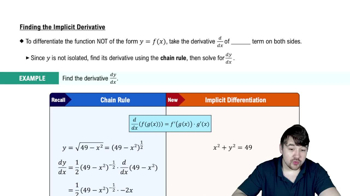
Finding The Implicit Derivative

Slope of a Curve

The slope of a curve at a given point is defined as the rate of change of the y-coordinate with respect to the x-coordinate at that point. Mathematically, it is represented by the derivative of the function at that point. For implicit functions, the slope can be found by evaluating dy/dx after applying implicit differentiation.
추천 영상:
11:41
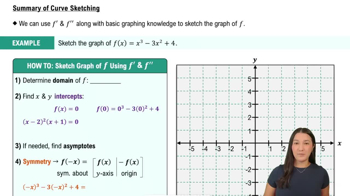
Summary of Curve Sketching

Evaluating Derivatives at a Point

Once the derivative (dy/dx) is found using implicit differentiation, the next step is to evaluate it at a specific point, in this case, (4, 1). This involves substituting the x and y values into the derivative expression to calculate the exact slope of the curve at that point, providing insight into the curve's behavior.
추천 영상:
04:50
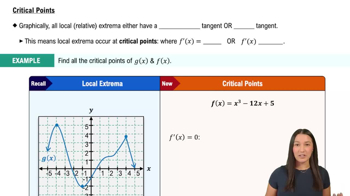
Critical Points
관련 실천
교과서 질문

97–100. Logistic growth Scientists often use the logistic growth function P(t) = P₀K / P₀+(K−P₀)e^−r₀t to model population growth, where P₀ is the initial population at time t=0, K is the carrying capacity, and r₀ is the base growth rate. The carrying capacity is a theoretical upper bound on the total population that the surrounding environment can support. The figure shows the sigmoid (S-shaped) curve associated with a typical logistic model. <IMAGE>


{Use of Tech} Gone fishing When a reservoir is created by a new dam, 50 fish are introduced into the reservoir, which has an estimated carrying capacity of 8000 fish. A logistic model of the fish population is P(t) = 400,000 / 50+7950e^−0.5t, where t is measured in years.


b. How long does it take for the population to reach 5000 fish? How long does it take for the population to reach 90% of the carrying capacity?

170
views
교과서 질문

45–50. Tangent lines Carry out the following steps. <IMAGE>

b. Determine an equation of the line tangent to the curve at the given point.

x³+y³=2xy; (1, 1)

269
views
교과서 질문

Consider the following cost functions.

b. Determine the average cost and the marginal cost when x=a.

C(x) = − 0.01x²+40x+100, 0≤x≤1500, a=1000

248
views
교과서 질문

Deriving trigonometric identities

b. Verify that you obtain the same identity for sin2t as in part (a) if you differentiate the identity cos 2t = 2 cos² t−1.

374
views
교과서 질문

21–30. Derivatives

b. Evaluate f'(a) for the given values of a.

f(t) = 1/√t; a=9, 1/4

361
views
교과서 질문

{Use of Tech} Computing limits with angles in degrees Suppose your graphing calculator has two functions, one called sin x, which calculates the sine of x when x is in radians, and the other called s(x), which calculates the sine of x when x is in degrees.

b. Evaluate lim x→0 s(x) / x. Verify your answer by estimating the limit on your calculator.

318
views