If f′(x)=3x+2, find the slope of the line tangent to the curve y=f(x) at x=1, 2, and 3.
Ch. 3 - Derivatives
3장, 문제 3.9.65
Calculate the derivative of the following functions. In some cases, it is useful to use the properties of logarithms to simplify the functions before computing f'(x).
y = (cos x) In cos²x
검증된 단계별 안내1
First, identify the function y = (cos x) ln(cos²x). Notice that it is a product of two functions: u(x) = cos(x) and v(x) = ln(cos²x).
Apply the product rule for derivatives, which states that if y = u(x) * v(x), then y' = u'(x) * v(x) + u(x) * v'(x).
Calculate the derivative of u(x) = cos(x). The derivative u'(x) is -sin(x).
Simplify v(x) = ln(cos²x) using the properties of logarithms: ln(cos²x) = 2 ln(cos(x)). Now, find the derivative v'(x). The derivative of ln(cos(x)) is -tan(x), so v'(x) = 2(-tan(x)) = -2tan(x).
Substitute u'(x), v(x), u(x), and v'(x) into the product rule formula: y' = (-sin(x)) * ln(cos²x) + cos(x) * (-2tan(x)). Simplify the expression to find the derivative.

비슷한 문제에 대한 검증된 영상 답변:
이 영상 해법은 위 문제에 도움이 된다고 튜터들이 추천한 것입니다.
영상 길이:
6m주요 개념
질문에 올바르게 답하기 위해 반드시 이해해야 하는 핵심 개념들은 다음과 같습니다.
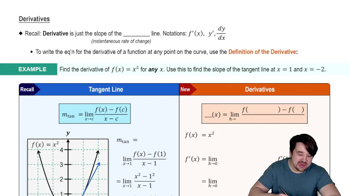
Derivative
The derivative of a function measures how the function's output value changes as its input value changes. It is a fundamental concept in calculus, representing the slope of the tangent line to the curve of the function at any given point. The derivative is denoted as f'(x) or dy/dx and can be calculated using various rules, such as the product rule, quotient rule, and chain rule.
추천 영상:
가이드 코스
Derivatives
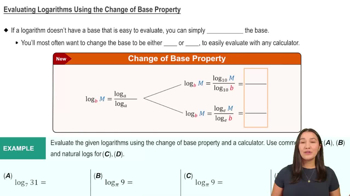
Logarithmic Properties
Logarithmic properties are rules that simplify the manipulation of logarithmic expressions. Key properties include the product rule (log(a*b) = log(a) + log(b)), the quotient rule (log(a/b) = log(a) - log(b)), and the power rule (log(a^b) = b*log(a)). These properties are particularly useful in calculus for simplifying complex functions before differentiation, making it easier to compute derivatives.
추천 영상:
Change of Base Property
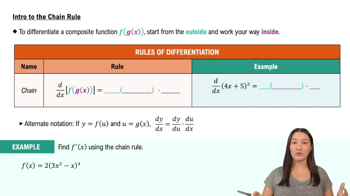
Chain Rule
The chain rule is a fundamental technique in calculus used to differentiate composite functions. It states that if a function y = f(g(x)) is composed of two functions, the derivative can be found by multiplying the derivative of the outer function f with the derivative of the inner function g. This rule is essential when dealing with functions that are nested within each other, allowing for the correct application of differentiation.
추천 영상:
Intro to the Chain Rule
관련 실천
교과서 질문
306
views
교과서 질문
A circle has an initial radius of 50 ft when the radius begins decreasing at a rate of 2 ft/min. What is the rate of change of the area at the instant the radius is 10 ft?
303
views
교과서 질문
Use Theorem 3.10 to evaluate the following limits.
lim x🠂0 (tan 7x) / (sin x)
358
views
교과서 질문
47–56. Derivatives of inverse functions at a point Consider the following functions. In each case, without finding the inverse, evaluate the derivative of the inverse at the given point.
f(x)=tan x; (1,π/4)
148
views
교과서 질문
Continuity of a piecewise function Let g(x) = <matrix 2x1> For what values of a is g continuous?
373
views
교과서 질문
Calculate the derivative of the following functions. In some cases, it is useful to use the properties of logarithms to simplify the functions before computing f'(x).
y = 4 log₃(x²−1)
205
views