Ch. 3 - Derivatives
Briggs - Calculus: Early Transcendentals 3rd Edition
Briggs3rd EditionCalculus: Early TranscendentalsISBN: 9780136847243당신이 사용하는 게 아니라요?교과서 변경
3장, 문제 56a

The energy (in joules) released by an earthquake of magnitude M is given by the equation E = 25,000 ⋅ 101.5M. (This equation can be solved for M to define the magnitude of a given earthquake; it is a refinement of the original Richter scale created by Charles Richter in 1935.)
Compute the energy released by earthquakes of magnitude 1, 2, 3, 4, and 5. Plot the points on a graph and join them with a smooth curve.

검증된 단계별 안내
1
Understand the given formula for energy released by an earthquake: E = 25,000 ⋅ 10^(1.5M). This formula relates the magnitude M of an earthquake to the energy E it releases.
To compute the energy for each magnitude, substitute the values of M (1, 2, 3, 4, and 5) into the formula one by one. For example, for M = 1, calculate E = 25,000 ⋅ 10^(1.5 * 1).
Repeat the substitution for each magnitude: M = 2, M = 3, M = 4, and M = 5, calculating the corresponding energy E for each case using the formula E = 25,000 ⋅ 10^(1.5M).
Once you have calculated the energy values for each magnitude, plot these points on a graph with the magnitude M on the x-axis and the energy E on the y-axis.
After plotting the points, draw a smooth curve through them to visualize how the energy released by an earthquake increases with its magnitude. This curve will help illustrate the exponential relationship between magnitude and energy.

비슷한 문제에 대한 검증된 영상 답변:

이 영상 해법은 위 문제에 도움이 된다고 튜터들이 추천한 것입니다.
영상 길이:
6m

주요 개념

질문에 올바르게 답하기 위해 반드시 이해해야 하는 핵심 개념들은 다음과 같습니다.

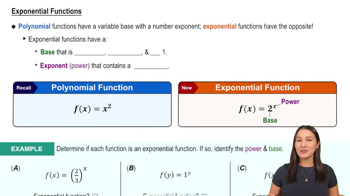
Exponential Functions

The equation E = 25,000 ⋅ 10^(1.5M) is an example of an exponential function, where the variable M (magnitude) affects the energy E exponentially. In exponential functions, a constant base is raised to a variable exponent, leading to rapid growth or decay. Understanding how to manipulate and evaluate exponential functions is crucial for calculating energy values for different magnitudes.
추천 영상:
6:13
Exponential Functions

Magnitude Scale

The magnitude of an earthquake, represented by M, is a logarithmic scale that quantifies the size of seismic events. Each whole number increase on the Richter scale corresponds to a tenfold increase in measured amplitude and approximately 31.6 times more energy release. This concept is essential for interpreting the results of the energy calculations and understanding the relationship between magnitude and energy.
추천 영상:
가이드 코스
06:21
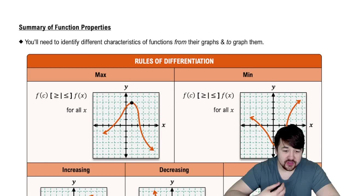
Properties of Functions

Graphing Data

Graphing involves plotting calculated values on a coordinate system to visualize relationships between variables. In this case, the magnitudes (M) will be plotted on the x-axis and the corresponding energy values (E) on the y-axis. Understanding how to create and interpret graphs is vital for analyzing the results and observing trends, such as the smooth curve that represents the relationship between magnitude and energy.
추천 영상:
가이드 코스
06:15
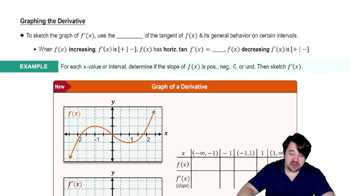
Graphing The Derivative
관련 실천
교과서 질문

Calculate the derivative of the following functions.

y = (1 - e0.05x)-1

351
views

교과서 질문

Find and simplify the derivative of the following functions.

h(x) = (5x7 + 5x)(6x3 + 3x2 + 3)

315
views
교과서 질문

Power and energy are often used interchangeably, but they are quite different. Energy is what makes matter move or heat up. It is measured in units of joules or Calories, where 1 Cal=4184 J. One hour of walking consumes roughly 10⁶J, or 240 Cal. On the other hand, power is the rate at which energy is used, which is measured in watts, where 1 W = 1 J/s. Other useful units of power are kilowatts (1 kW=10³ W) and megawatts (1 MW=10⁶ W). If energy is used at a rate of 1 kW for one hour, the total amount of energy used is 1 kilowatt-hour (1 kWh = 3.6×10⁶ J) Suppose the cumulative energy used in a large building over a 24-hr period is given by E(t)=100t + 4t² − (t³ / 9) kWh where t = 0 corresponds to midnight.

The power is the rate of energy consumption; that is, P(t) = E′(t) Find the power over the interval 0 ≤ t ≤ 24.

452
views
교과서 질문

An object oscillates along a vertical line, and its position in centimeters is given by y(t)=30(sint - 1), where t ≥ 0 is measured in seconds and y is positive in the upward direction.

At what times and positions is the velocity zero?

216
views
교과서 질문

An object oscillates along a vertical line, and its position in centimeters is given by y(t) = 30(sin t - 1), where t ≥ 0 is measured in seconds and y is positive in the upward direction.

The acceleration of the oscillator is a(t) = v′(t). Find and graph the acceleration function.

220
views
교과서 질문

Calculate the derivative of the following functions.

y = cos7/4(4x3)

357
views