
Piston compression A piston is seated at the top of a cylindrical chamber with radius 5 cm when it starts moving into the chamber at a constant speed of 3 cm/s (see figure). What is the rate of change of the volume of the cylinder when the piston is 2 cm from the base of the chamber? <IMAGE>
Ch. 3 - Derivatives
3장, 문제 3.10.5
Suppose f is a one-to-one function with f(2)=8 and f′(2)=4. What is the value of (f^−1)′(8)?
검증된 단계별 안내1
Step 1: Recall the formula for the derivative of the inverse function. If f is a one-to-one function and differentiable at a point, then the derivative of its inverse function at a point is given by: \((f^{-1})'(b) = \frac{1}{f'(a)}\), where \(f(a) = b\).
Step 2: Identify the given values in the problem. We know that \(f(2) = 8\) and \(f'(2) = 4\).
Step 3: Match the given values to the formula. Here, \(a = 2\) and \(b = 8\), so we need to find \((f^{-1})'(8)\).
Step 4: Substitute the known values into the formula. Using \((f^{-1})'(b) = \frac{1}{f'(a)}\), substitute \(f'(2) = 4\) into the formula to find \((f^{-1})'(8)\).
Step 5: Calculate the expression \((f^{-1})'(8) = \frac{1}{4}\). This gives the value of the derivative of the inverse function at the point where \(f(x) = 8\).

비슷한 문제에 대한 검증된 영상 답변:
이 영상 해법은 위 문제에 도움이 된다고 튜터들이 추천한 것입니다.
영상 길이:
2m주요 개념
질문에 올바르게 답하기 위해 반드시 이해해야 하는 핵심 개념들은 다음과 같습니다.
Inverse Function Theorem
The Inverse Function Theorem states that if a function f is continuously differentiable and has a non-zero derivative at a point, then its inverse function f⁻¹ is also differentiable at the corresponding point. Specifically, if f'(a) ≠ 0, then (f⁻¹)'(f(a)) = 1 / f'(a). This theorem is crucial for finding the derivative of an inverse function.
추천 영상:
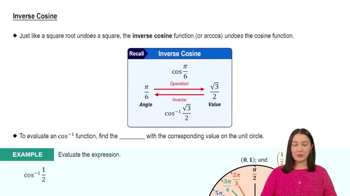
Inverse Cosine
One-to-One Function
A one-to-one function, or injective function, is a function where each output is produced by exactly one input. This property ensures that the function has an inverse, as it guarantees that for every y in the range, there is a unique x in the domain such that f(x) = y. In this problem, knowing that f is one-to-one allows us to confidently apply the Inverse Function Theorem.
추천 영상:
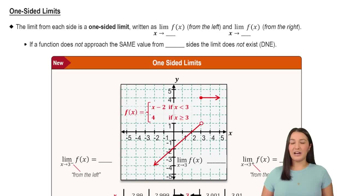
One-Sided Limits
Derivative of a Function
The derivative of a function at a point measures the rate at which the function's value changes as its input changes. It is defined as the limit of the average rate of change as the interval approaches zero. In this context, f′(2) = 4 indicates that at x = 2, the function f is increasing at a rate of 4 units of output for every 1 unit of input, which is essential for calculating the derivative of the inverse function.
추천 영상:
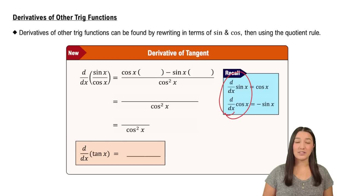
Derivatives of Other Trig Functions
관련 실천
교과서 질문
291
views
교과서 질문
Find y'' for the following functions.
y = x sin x
368
views
교과서 질문
Find (f^−1)′(3), where f(x)=x³+x+1.
203
views
교과서 질문
Use implicit differentiation to find dy/dx.
sin xy = x+y
556
views
교과서 질문
Calculate the derivative of the following functions (i) using the fact that bx = exIn b and (ii) using logarithmic differentiation. Verify that both answers are the same.
y = (4x+1)In x
187
views
교과서 질문
90–93. {Use of Tech} Work carefully Proceed with caution when using implicit differentiation to find points at which a curve has a specified slope. For the following curves, find the points on the curve (if they exist) at which the tangent line is horizontal or vertical. Once you have found possible points, make sure that they actually lie on the curve. Confirm your results with a graph.
x(1−y²)+y³=0
189
views
