Ch. 3 - Derivatives
Briggs - Calculus: Early Transcendentals 3rd Edition
Briggs3rd EditionCalculus: Early TranscendentalsISBN: 9780136847243당신이 사용하는 게 아니라요?교과서 변경
3장, 문제 19a

Use definition (1) (p. 133) to find the slope of the line tangent to the graph of f at P.
f(x) = √(3x + 3); P(2,3)

검증된 단계별 안내
1
Step 1: Recall the definition of the derivative as the slope of the tangent line at a point. The derivative of a function f at a point x = a is given by the limit: f'(a) = \(\lim\)_{h \(\to\) 0} \(\frac{f(a+h) - f(a)}{h}\).
Step 2: Identify the function f(x) = \(\sqrt{3x + 3}\) and the point P(2, 3). Here, a = 2, and f(a) = f(2) = 3, which matches the y-coordinate of point P.
Step 3: Substitute a = 2 into the derivative definition: f'(2) = \(\lim\)_{h \(\to\) 0} \(\frac{f(2+h) - f(2)}{h}\).
Step 4: Calculate f(2+h) by substituting into the function: f(2+h) = \(\sqrt{3(2+h) + 3}\) = \(\sqrt{6 + 3h + 3}\) = \(\sqrt{9 + 3h}\).
Step 5: Substitute f(2+h) and f(2) into the limit expression: f'(2) = \(\lim\)_{h \(\to\) 0} \(\frac{\sqrt{9 + 3h}\) - 3}{h}. Simplify and evaluate this limit to find the slope of the tangent line.

비슷한 문제에 대한 검증된 영상 답변:

이 영상 해법은 위 문제에 도움이 된다고 튜터들이 추천한 것입니다.
영상 길이:
5m

주요 개념

질문에 올바르게 답하기 위해 반드시 이해해야 하는 핵심 개념들은 다음과 같습니다.

Tangent Line

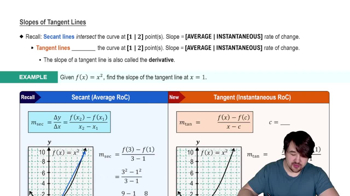
A tangent line to a curve at a given point is a straight line that touches the curve at that point without crossing it. The slope of the tangent line represents the instantaneous rate of change of the function at that point, which is crucial for understanding how the function behaves locally.
추천 영상:
가이드 코스
05:13
Slopes of Tangent Lines

Derivative

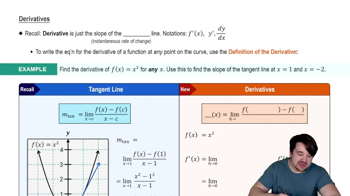
The derivative of a function at a point quantifies how the function's output changes as its input changes. It is defined as the limit of the average rate of change of the function as the interval approaches zero. In this context, finding the derivative of f(x) will provide the slope of the tangent line at point P.
추천 영상:

Limit Definition of Derivative

The limit definition of the derivative states that the derivative f'(a) at a point a is the limit of the difference quotient as h approaches zero: f'(a) = lim(h→0) [(f(a+h) - f(a))/h]. This definition is fundamental for calculating the slope of the tangent line, as it formalizes the concept of instantaneous rate of change.
추천 영상:
가이드 코스
05:43
Definition of the Definite Integral
관련 실천
교과서 질문

5–24. For each of the following composite functions, find an inner function u=g(x) and an outer function y=f(u) such that y=f(g(x)). Then calculate dy/dx.

y = √7x-1

258
views

교과서 질문

5–24. For each of the following composite functions, find an inner function u=g(x) and an outer function y=f(u) such that y=f(g(x)). Then calculate dy/dx.

y = √x²+1

237
views
교과서 질문

Suppose the position of an object moving horizontally along a line after t seconds is given by the following functions s = f(t), where s is measured in feet, with s > 0 corresponding to positions right of the origin.

On what intervals is the speed increasing?

f(t) = 18t - 3t2; 0 ≤ t ≤ 8

230
views
교과서 질문

Suppose the position of an object moving horizontally along a line after t seconds is given by the following functions s = f(t), where s is measured in feet, with s > 0 corresponding to positions right of the origin.

Determine the velocity and acceleration of the object at t = 1. 

f(t) = 2t3 - 21t2 + 60t; 0 ≤ t ≤ 6

198
views
교과서 질문

Position, velocity, and acceleration Suppose the position of an object moving horizontally along a line after t seconds is given by the following functions s = f(t), where s is measured in feet, with s > 0 corresponding to positions right of the origin.

a. Graph the position function.

f(t)=6t3+36t2−54t;0≤t≤4f(t)=6t^3+36t^2-54t;0\(\le\) t\(\le\)4

349
views
교과서 질문

Position, velocity, and acceleration Suppose the position of an object moving horizontally along a line after t seconds is given by the following functions s = f(t), where s is measured in feet, with s > 0 corresponding to positions right of the origin.

b. Find and graph the velocity function. When is the object stationary, moving to the right, and moving to the left?

f(t) = 18t-3t²; 0 ≤ t ≤ 8

290
views