
Ch. 3 - Derivatives
Briggs - Calculus: Early Transcendentals 3rd Edition
Briggs3rd EditionCalculus: Early TranscendentalsISBN: 9780136847243당신이 사용하는 게 아니라요?교과서 변경
3장, 문제 3.7.105b

{Use of Tech} Power and energy The total energy in megawatt-hr (MWh) used by a town is given by E(t) = 400t+2400/π sin πt/12, where t≥0 is measured in hours, with t=0 corresponding to noon.
b. At what time of day is the rate of energy consumption a maximum? What is the power at that time of day?

검증된 단계별 안내
1
Step 1: To find the time of day when the rate of energy consumption is a maximum, we need to find the derivative of the energy function E(t) with respect to time t. This derivative, E'(t), represents the rate of energy consumption, also known as power.
Step 2: Differentiate E(t) = 400t + \(\frac{2400}{\pi}\) \(\sin\[\left\)(\(\frac{\pi t}{12}\]\right\)) with respect to t. Use the derivative rules: the derivative of 400t is 400, and for the sine term, use the chain rule. The derivative of \(\sin\[\left\)(\(\frac{\pi t}{12}\]\right\)) is \(\cos\[\left\)(\(\frac{\pi t}{12}\]\right\)) \(\cdot\) \(\frac{\pi}{12}\).
Step 3: Set the derivative E'(t) equal to zero to find the critical points. This will help us determine when the rate of energy consumption is at a maximum or minimum. Solve the equation 400 + \(\frac{2400}{\pi}\) \(\cdot\) \(\cos\[\left\)(\(\frac{\pi t}{12}\]\right\)) \(\cdot\) \(\frac{\pi}{12}\) = 0 for t.
Step 4: Solve the equation from Step 3 for t to find the critical points. This involves isolating the cosine term and using inverse trigonometric functions to find the values of t that satisfy the equation.
Step 5: Evaluate the second derivative, E''(t), to determine the concavity at the critical points found in Step 4. If E''(t) is negative at a critical point, it indicates a local maximum. Use this information to identify the time of day when the rate of energy consumption is a maximum.

비슷한 문제에 대한 검증된 영상 답변:

이 영상 해법은 위 문제에 도움이 된다고 튜터들이 추천한 것입니다.
영상 길이:
8m

주요 개념

질문에 올바르게 답하기 위해 반드시 이해해야 하는 핵심 개념들은 다음과 같습니다.

Energy Function

The energy function E(t) represents the total energy consumed over time, where E(t) = 400t + (2400/π) sin(πt/12). Understanding this function is crucial as it describes how energy consumption varies with time, allowing us to analyze its behavior and derive important characteristics such as maximum consumption.
추천 영상:
가이드 코스
06:21
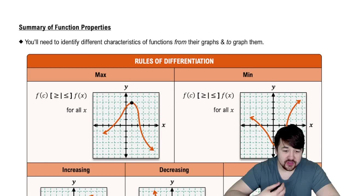
Properties of Functions

Rate of Change

The rate of energy consumption is determined by the derivative of the energy function, E'(t). This derivative indicates how quickly energy is being consumed at any given time, and finding its maximum value will help identify when the energy consumption is at its peak.
추천 영상:
가이드 코스
04:16
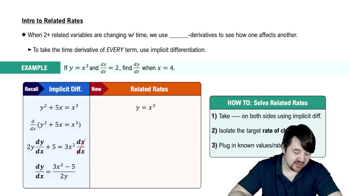
Intro To Related Rates

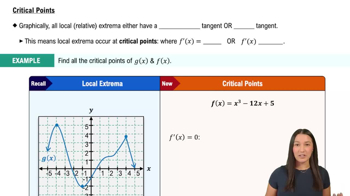
Critical Points

Critical points occur where the derivative E'(t) is zero or undefined. These points are essential for determining local maxima or minima in the energy consumption function. By analyzing these points, we can find the specific time of day when the rate of energy consumption reaches its maximum.
추천 영상:
04:50
Critical Points