Ch. 5 - Integration
Briggs - Calculus: Early Transcendentals 3rd Edition
Briggs3rd EditionCalculus: Early TranscendentalsISBN: 9780136847243당신이 사용하는 게 아니라요?교과서 변경
5장, 문제 5.1.17

Approximating displacement The velocity of an object is given by the following functions on a specified interval. Approximate the displacement of the object on this interval by subdividing the interval into n subintervals. Use the left endpoint of each subinterval to compute the height of the rectangles.
v = 2t + 1(m/s), for 0 ≤ t ≤ 8 ; n = 2

검증된 단계별 안내
1
Step 1: Understand the problem. The goal is to approximate the displacement of the object over the interval [0, 8] using the velocity function v = 2t + 1. The interval is subdivided into n = 2 subintervals, and the left endpoint of each subinterval is used to compute the height of the rectangles.
Step 2: Divide the interval [0, 8] into n = 2 subintervals. The width of each subinterval (Δt) is calculated as Δt = (8 - 0) / 2 = 4. So the subintervals are [0, 4] and [4, 8].
Step 3: Determine the left endpoints of each subinterval. For the subinterval [0, 4], the left endpoint is t = 0. For the subinterval [4, 8], the left endpoint is t = 4.
Step 4: Evaluate the velocity function v = 2t + 1 at each left endpoint. For t = 0, v(0) = 2(0) + 1 = 1. For t = 4, v(4) = 2(4) + 1 = 9.
Step 5: Approximate the displacement by summing the areas of the rectangles. The area of each rectangle is given by height × width. For the first rectangle, the area is v(0) × Δt = 1 × 4. For the second rectangle, the area is v(4) × Δt = 9 × 4. Add these areas together to approximate the total displacement.

비슷한 문제에 대한 검증된 영상 답변:

이 영상 해법은 위 문제에 도움이 된다고 튜터들이 추천한 것입니다.
영상 길이:
3m

주요 개념

질문에 올바르게 답하기 위해 반드시 이해해야 하는 핵심 개념들은 다음과 같습니다.

Velocity and Displacement

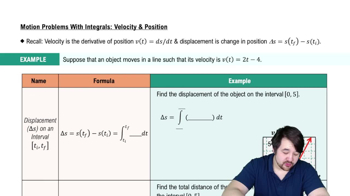
Velocity is the rate of change of displacement with respect to time. In this context, the velocity function v(t) = 2t + 1 describes how the object's speed changes over time. Displacement can be approximated by integrating the velocity function over a specified interval, which gives the total change in position of the object.
추천 영상:
가이드 코스
10:17
Using The Velocity Function

Riemann Sums

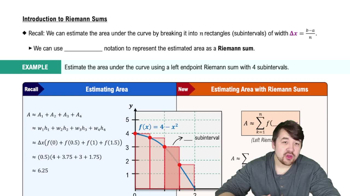
Riemann sums are a method for approximating the integral of a function, which in this case represents the displacement. By dividing the interval into n subintervals and using the left endpoint of each subinterval to determine the height of rectangles, we can estimate the area under the velocity curve. This area corresponds to the total displacement over the interval.
추천 영상:
가이드 코스
06:11
Introduction to Riemann Sums

Subintervals and Left Endpoint Approximation

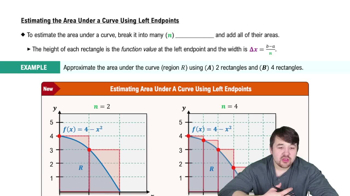
Subdividing the interval into n subintervals allows for a more manageable calculation of the area under the curve. The left endpoint approximation specifically uses the value of the function at the left end of each subinterval to calculate the height of the rectangles. This method provides a way to estimate the integral, which is particularly useful when the exact integral is difficult to compute.
추천 영상:
가이드 코스
07:59
Estimating the Area Under a Curve Using Left Endpoints
관련 실천
교과서 질문

Approximating displacement The velocity of an object is given by the following functions on a specified interval. Approximate the displacement of the object on this interval by subdividing the interval into n subintervals. Use the left endpoint of each subinterval to compute the height of the rectangles.

v = [1 / (2t + 1)] (m/s), for 0 ≤ t ≤ 8 ; n = 4

52
views
교과서 질문

Average value of the derivative Suppose ƒ ' is a continuous function for all real numbers. Show that the average value of the derivative on an interval [a, b] is ƒ⁻' = (ƒ(b) ―ƒ(a))/ (b―a) . Interpret this result in terms of secant lines.

128
views
교과서 질문

General results Evaluate the following integrals in which the function ƒ is unspecified. Note that ƒ⁽ᵖ⁾ is the pth derivative of ƒ and ƒᵖ is the pth power of ƒ. Assume ƒ and its derivatives are continuous for all real numbers. 

∫ (5 ƒ³ (𝓍) + 7ƒ² (𝓍) + ƒ (𝓍 )) ƒ'(𝓍) d𝓍

85
views
교과서 질문

The linear function ƒ(𝓍) = 3 ― 𝓍 is decreasing on the interval [0, 3]. Is its area function for ƒ (with left endpoint 0) increasing or decreasing on the interval [0, 3]? Draw a picture and explain. 

75
views
교과서 질문

Variations on the substitution method Evaluate the following integrals.                                                                                                        


 ∫ y²/(y + 1)⁴ dy

66
views
교과서 질문

Derivatives of integrals Simplify the following expressions.


d/d𝓍 ∫₀ˣ (√1 + t²) dt (Hint: ∫ˣ₋ₓ (√1 + t²) dt = ∫⁰₋ₓ (√1 + t²) dt + ∫ˣ₋ₓ (√1 + t²) dt ) .

60
views