Ch. 5 - Integration
Briggs - Calculus: Early Transcendentals 3rd Edition
Briggs3rd EditionCalculus: Early TranscendentalsISBN: 9780136847243당신이 사용하는 게 아니라요?교과서 변경
5장, 문제 5.R.81

Evaluating integrals Evaluate the following integrals.


∫√₂/₅^²/⁵ d𝓍/𝓍√(25𝓍² ―1)

검증된 단계별 안내
1
Step 1: Recognize the integral's structure. The given integral involves a square root in the denominator and a term resembling the derivative of an inverse trigonometric function. Specifically, it resembles the form of an integral involving arcsine or arctangent.
Step 2: Simplify the denominator. Notice that the denominator is √(25𝓍² - 1). Factor out 25 from the square root to rewrite it as √(25(𝓍² - 1/25)). This simplifies the expression inside the square root.
Step 3: Perform a substitution. Let u = 𝓍, and rewrite the integral in terms of u. This substitution helps simplify the integral further and prepares it for evaluation using standard formulas.
Step 4: Identify the standard formula. The integral now resembles the form ∫ du / u√(a²u² - b²), which can be solved using the formula for inverse trigonometric functions. Specifically, it matches the form of an arcsine or arctangent integral.
Step 5: Apply the formula and adjust for constants. Use the appropriate inverse trigonometric formula, ensuring to account for the constants (like 25) introduced during simplification. After applying the formula, simplify the result and include the constant of integration.

비슷한 문제에 대한 검증된 영상 답변:

이 영상 해법은 위 문제에 도움이 된다고 튜터들이 추천한 것입니다.
영상 길이:
2m

주요 개념

질문에 올바르게 답하기 위해 반드시 이해해야 하는 핵심 개념들은 다음과 같습니다.

Definite Integrals

Definite integrals represent the signed area under a curve between two specified limits. They are calculated using the Fundamental Theorem of Calculus, which connects differentiation and integration. Understanding how to evaluate definite integrals is crucial for solving problems involving areas, volumes, and other applications in calculus.
추천 영상:
가이드 코스
05:43
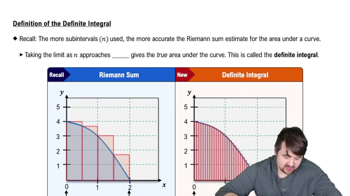
Definition of the Definite Integral

Substitution Method

The substitution method is a technique used to simplify the process of evaluating integrals. By substituting a part of the integrand with a new variable, the integral can often be transformed into a more manageable form. This method is particularly useful when dealing with composite functions or when the integrand contains a function and its derivative.
추천 영상:
07:33
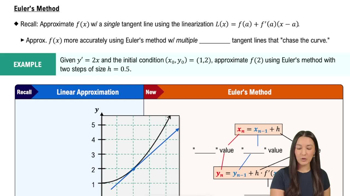
Euler's Method

Integration of Rational Functions

Integrating rational functions involves finding the integral of a fraction where both the numerator and denominator are polynomials. Techniques such as partial fraction decomposition may be employed to break down complex rational functions into simpler components that are easier to integrate. Mastery of this concept is essential for evaluating integrals that appear in various calculus problems.
추천 영상:
6:04
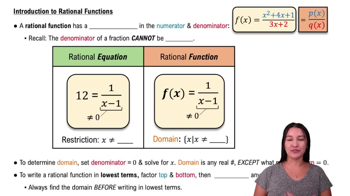
Intro to Rational Functions
관련 실천
교과서 질문

Area versus net area Find (i) the net area and (ii) the area of the region bounded by the graph of ƒ and the 𝓍-axis on the given interval. You may find it useful to sketch the region.

ƒ(𝓍) = 𝓍⁴ ― 𝓍² on [―1, 1]

152
views
교과서 질문

Find the average value of ƒ(𝓍) = e²ˣ on [0, ln 2] .

53
views
교과서 질문

Evaluating integrals Evaluate the following integrals.                                                                                                                                         


 ∫(√1 + tan 2t) sec² 2t dt

68
views
교과서 질문

Area by geometry Use geometry to evaluate the following definite integrals, where the graph of ƒ is given in the figure.

(c) ∫₅⁷ ƒ(𝓍) d𝓍

74
views
교과서 질문

Area by geometry Use geometry to evaluate the following definite integrals, where the graph of ƒ is given in the figure.


(d) ∫₀⁷ ƒ(𝓍) d𝓍

56
views
교과서 질문

Evaluating integrals Evaluate the following integrals.                                                                                                                                         


 ∫ 𝓍⁷ √(𝓍⁴ + 1d𝓍)

68
views