Ch. 5 - Integration
Briggs - Calculus: Early Transcendentals 3rd Edition
Briggs3rd EditionCalculus: Early TranscendentalsISBN: 9780136847243당신이 사용하는 게 아니라요?교과서 변경
5장, 문제 5.3.10

Explain why ∫ₐᵇ ƒ ′(𝓍) d𝓍 = ƒ(b) ― ƒ(a)

검증된 단계별 안내
1
Step 1: Recall the Fundamental Theorem of Calculus, Part 1, which states that if a function ƒ is continuous on [a, b] and differentiable on (a, b), then the integral of its derivative ƒ′(𝓍) over [a, b] is equal to the net change in ƒ(𝓍) over that interval.
Step 2: Write the mathematical expression for the Fundamental Theorem of Calculus: ∫ₐᵇ ƒ′(𝓍) d𝓍 = ƒ(b) ― ƒ(a). This equation shows that the definite integral of the derivative of ƒ(𝓍) from a to b gives the difference between the values of ƒ(𝓍) at the endpoints b and a.
Step 3: Conceptually, the derivative ƒ′(𝓍) represents the rate of change of the function ƒ(𝓍). Integrating ƒ′(𝓍) over the interval [a, b] accumulates all the infinitesimal changes in ƒ(𝓍) over that interval, resulting in the total change in ƒ(𝓍) from a to b.
Step 4: To understand this geometrically, think of the integral ∫ₐᵇ ƒ′(𝓍) d𝓍 as calculating the area under the curve of ƒ′(𝓍) over [a, b]. This area corresponds to the net change in the original function ƒ(𝓍) over the interval.
Step 5: Finally, note that this relationship holds because differentiation and integration are inverse operations. The integral essentially 'undoes' the differentiation, leaving you with the original function evaluated at the endpoints: ƒ(b) ― ƒ(a).

비슷한 문제에 대한 검증된 영상 답변:

이 영상 해법은 위 문제에 도움이 된다고 튜터들이 추천한 것입니다.
영상 길이:
1m

주요 개념

질문에 올바르게 답하기 위해 반드시 이해해야 하는 핵심 개념들은 다음과 같습니다.

Fundamental Theorem of Calculus

The Fundamental Theorem of Calculus connects differentiation and integration, stating that if a function is continuous on [a, b] and F is an antiderivative of f on that interval, then the integral of f from a to b equals F(b) - F(a). This theorem provides a powerful tool for evaluating definite integrals and establishes the relationship between the two main branches of calculus.
추천 영상:
가이드 코스
06:11
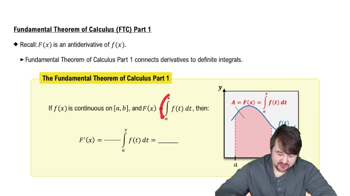
Fundamental Theorem of Calculus Part 1

Antiderivative

An antiderivative of a function f is another function F such that F' = f. In the context of the integral ∫ₐᵇ ƒ ′(𝓍) d𝓍, the function F is the antiderivative of f', meaning that F is the original function f before differentiation. This concept is crucial for understanding how integration reverses the process of differentiation.
추천 영상:
가이드 코스
05:50
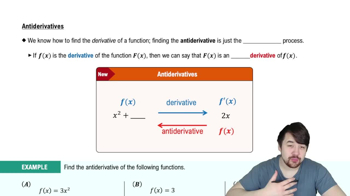
Antiderivatives

Definite Integral

A definite integral, represented as ∫ₐᵇ f(x) dx, calculates the net area under the curve of the function f(x) from x = a to x = b. It provides a numerical value that represents the accumulation of quantities, such as area, over an interval. The result of a definite integral is a specific number, which in the case of ∫ₐᵇ ƒ ′(𝓍) d𝓍, corresponds to the difference in the values of the antiderivative at the endpoints b and a.
추천 영상:
가이드 코스
05:43
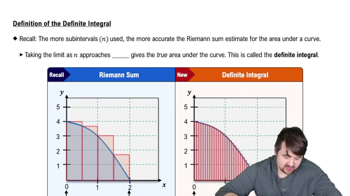
Definition of the Definite Integral
관련 실천
교과서 질문

Variations on the substitution method Evaluate the following integrals.                                                                                                        


 ∫ 𝓍/(√𝓍―4) d𝓍

67
views

교과서 질문

Indefinite integrals Use a change of variables or Table 5.6 to evaluate the following indefinite integrals. Check your work by differentiating.                                                                                  


 ∫ 2𝓍(𝓍² ― 1)⁹⁹ d𝓍

86
views
교과서 질문

Indefinite integrals Use a change of variables or Table 5.6 to evaluate the following indefinite integrals. Check your work by differentiating.                                                                                  


 ∫ [ 1/(10𝓍―3) d𝓍

57
views
교과서 질문

Multiple substitutions If necessary, use two or more substitutions to find the following integrals.                                                                                    


  ∫₀^π/² (cos θ sin θ) / √(cos² θ + 16) dθ (Hint: Begin with u = cos θ .)

44
views
교과서 질문

Suppose an object moves along a line at 15 m/s, for 0 ≤ t < 2 and at 25 m/s, for 2 ≤ t ≤ 5, where t is measured in seconds. Sketch the graph of the velocity function and find the displacement of the object for 0 ≤ t ≤ 5.

47
views
교과서 질문

Definite integrals from graphs The figure shows the areas of regions bounded by the graph of ƒ and the 𝓍-axis. Evaluate the following integrals.


∫ₐᶜ ƒ(𝓍) d𝓍

102
views