Ch. 5 - Integration
Briggs - Calculus: Early Transcendentals 3rd Edition
Briggs3rd EditionCalculus: Early TranscendentalsISBN: 9780136847243당신이 사용하는 게 아니라요?교과서 변경
5장, 문제 5.1.65

Identifying Riemann sums Fill in the blanks with an interval and a value of n.


4
∑ ƒ (1 + k) • 1 is a right Riemann sum for f on the interval [ ___ , ___ ] with
k = 1
n = ________ .

검증된 단계별 안내
1
Step 1: Understand the structure of the Riemann sum. A Riemann sum approximates the area under a curve by summing up the areas of rectangles. The given sum is a right Riemann sum, which means the function values are evaluated at the right endpoints of the subintervals.
Step 2: Analyze the given sum. The expression ƒ(1 + k) • 1 suggests that the interval starts at 1, and the width of each subinterval (Δx) is 1. The term 'k' represents the index of the subintervals.
Step 3: Determine the interval. Since the sum starts at k = 1 and increments by 1 for each term, the interval can be determined by the range of values for x. The interval is [1, 1 + n], where n is the number of subintervals.
Step 4: Identify the value of n. The summation symbol (∑) indicates that there are 4 terms in the sum, which means n = 4. This corresponds to the number of subintervals used in the approximation.
Step 5: Fill in the blanks. Based on the analysis, the interval is [1, 5] (since n = 4 and the interval ends at 1 + n), and the value of n is 4.

비슷한 문제에 대한 검증된 영상 답변:

이 영상 해법은 위 문제에 도움이 된다고 튜터들이 추천한 것입니다.
영상 길이:
4m

주요 개념

질문에 올바르게 답하기 위해 반드시 이해해야 하는 핵심 개념들은 다음과 같습니다.

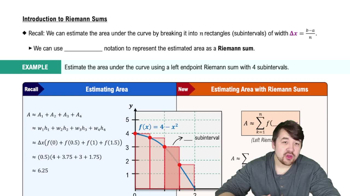
Riemann Sums

Riemann sums are a method for approximating the definite integral of a function over an interval. They involve dividing the interval into smaller subintervals, calculating the function's value at specific points within these subintervals, and summing the products of these values and the widths of the subintervals. The choice of points (left, right, or midpoint) affects the approximation's accuracy.
추천 영상:
가이드 코스
06:11
Introduction to Riemann Sums

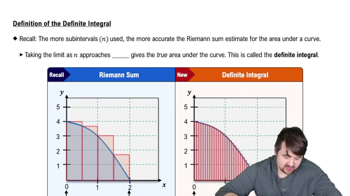
Definite Integral

The definite integral of a function over an interval represents the net area under the curve of the function between two points. It is calculated as the limit of Riemann sums as the number of subintervals approaches infinity. This concept is fundamental in calculus, linking the idea of accumulation with the geometric interpretation of area.
추천 영상:
가이드 코스
05:43
Definition of the Definite Integral

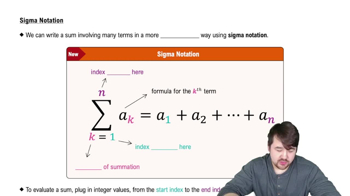
Interval Notation

Interval notation is a mathematical notation used to represent a range of values. It specifies the lower and upper bounds of the interval, using brackets [ ] for inclusive endpoints and parentheses ( ) for exclusive endpoints. Understanding interval notation is crucial for correctly identifying the limits of integration when working with Riemann sums and definite integrals.
추천 영상:
관련 실천
교과서 질문

Indefinite integrals Use a change of variables or Table 5.6 to evaluate the following indefinite integrals. Check your work by differentiating.                                                                                  


 ∫ sin 𝓍 sec⁸ 𝓍 d𝓍

69
views
교과서 질문

Definite integrals Use a change of variables or Table 5.6 to evaluate the following definite integrals.                                                                                                                         


 ∫₀¹ 2e²ˣ d𝓍

74
views
교과서 질문

Let ƒ(𝓍) = c, where c is a positive constant. Explain why an area function of ƒ is an increasing function.

72
views
교과서 질문

Areas of regions Find the area of the region bounded by the graph of ƒ and the 𝓍-axis on the given interval.


ƒ(𝓍) = sin 𝓍 on [―π/4, 3π/4]

108
views
교과서 질문

Is x¹² an even or odd function? Is sin x² an even or odd function?

74
views
교과서 질문

Symmetry in integrals Use symmetry to evaluate the following integrals.

∫²₋₂ (x² + x³) dx

113
views