Ch. 5 - Integration
5์žฅ, ๋ฌธ์ œ 5.R.96a

Velocity to displacement An object travels on the ๐“-axis with a velocity given by v(t) = 2t + 5, for 0 โ‰ค t โ‰ค 4.


(a) How far does the object travel, for 0 โ‰ค t โ‰ค 4 ?

๊ฒ€์ฆ๋œ ๋‹จ๊ณ„๋ณ„ ์•ˆ๋‚ด
1
Step 1: Recognize that the displacement of the object can be found by integrating the velocity function v(t) = 2t + 5 over the given time interval [0, 4]. The formula for displacement is: \( s(t) = \int v(t) \, dt \).
Step 2: Set up the definite integral for displacement: \( \int_{0}^{4} (2t + 5) \, dt \). This represents the total distance traveled by the object from t = 0 to t = 4.
Step 3: Break the integral into two parts for easier computation: \( \int_{0}^{4} 2t \, dt + \int_{0}^{4} 5 \, dt \).
Step 4: Compute each integral separately. For \( \int_{0}^{4} 2t \, dt \), use the power rule of integration: \( \int t^n \, dt = \frac{t^{n+1}}{n+1} \). For \( \int_{0}^{4} 5 \, dt \), treat 5 as a constant and multiply it by the length of the interval.
Step 5: Add the results of the two integrals together to find the total displacement. This will give the total distance traveled by the object over the interval [0, 4].

๋น„์Šทํ•œ ๋ฌธ์ œ์— ๋Œ€ํ•œ ๊ฒ€์ฆ๋œ ์˜์ƒ ๋‹ต๋ณ€:

์ด ์˜์ƒ ํ•ด๋ฒ•์€ ์œ„ ๋ฌธ์ œ์— ๋„์›€์ด ๋œ๋‹ค๊ณ  ํŠœํ„ฐ๋“ค์ด ์ถ”์ฒœํ•œ ๊ฒƒ์ž…๋‹ˆ๋‹ค.
์˜์ƒ ๊ธธ์ด:
2m

์ฃผ์š” ๊ฐœ๋…

์งˆ๋ฌธ์— ์˜ฌ๋ฐ”๋ฅด๊ฒŒ ๋‹ตํ•˜๊ธฐ ์œ„ํ•ด ๋ฐ˜๋“œ์‹œ ์ดํ•ดํ•ด์•ผ ํ•˜๋Š” ํ•ต์‹ฌ ๊ฐœ๋…๋“ค์€ ๋‹ค์Œ๊ณผ ๊ฐ™์Šต๋‹ˆ๋‹ค.

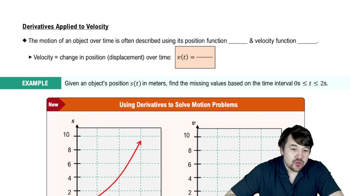
Velocity

Velocity is the rate of change of an object's position with respect to time. In this context, the velocity function v(t) = 2t + 5 describes how the object's speed changes over time. Understanding velocity is crucial for determining how far the object travels over a given time interval.
์ถ”์ฒœ ์˜์ƒ:
๊ฐ€์ด๋“œ ์ฝ”์Šค
06:29
Derivatives Applied To Velocity

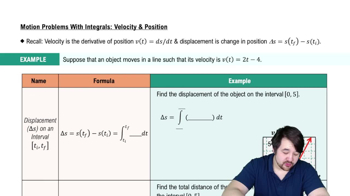
Displacement

Displacement refers to the change in position of an object and can be calculated as the integral of the velocity function over a specific time interval. In this case, to find the total distance traveled by the object from t = 0 to t = 4, we need to integrate the velocity function v(t) over that interval.
์ถ”์ฒœ ์˜์ƒ:

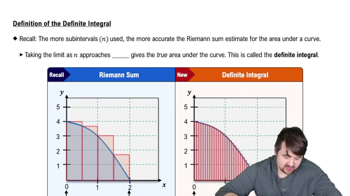
Definite Integral

A definite integral calculates the accumulation of quantities, such as area under a curve, over a specified interval. In this problem, we will use the definite integral of the velocity function from t = 0 to t = 4 to find the total distance traveled by the object, which is essential for solving the question.
์ถ”์ฒœ ์˜์ƒ:
๊ฐ€์ด๋“œ ์ฝ”์Šค
05:43
Definition of the Definite Integral
๊ด€๋ จ ์‹ค์ฒœ
๊ต๊ณผ์„œ ์งˆ๋ฌธ

Integration by Riemann sums Consider the integral โˆซโ‚โด (3๐“โ€• 2) d๐“.


(b) Use summation notation to express the right Riemann sum in terms of a positive integer n .

100
views
๊ต๊ณผ์„œ ์งˆ๋ฌธ

Function defined by an integral Let H (๐“) = โˆซโ‚€หฃ โˆš(4 โ€• tยฒ) dt, for โ€• 2 โ‰ค ๐“ โ‰ค 2.

(a) Evaluate H (0) .

61
views
๊ต๊ณผ์„œ ์งˆ๋ฌธ

(b) Find the average value of ฦ’ shown in the figure on the interval [2,6] and then find the point(s) c in (2, 6) guaranteed to exist by the Mean Value Theorem for Integrals. 

47
views
๊ต๊ณผ์„œ ์งˆ๋ฌธ

Use geometry and properties of integrals to evaluate the following definite integrals.

โˆซโ‚„โฐ (2๐“ + โˆš(16โ€•๐“ยฒ)) d๐“ . (Hint: Write the integral as sum of two integrals.)

114
views
๊ต๊ณผ์„œ ์งˆ๋ฌธ

Area functions and the Fundamental Theorem Consider the function

ฦ’(t) = { t      if  โ€•2 โ‰ค t < 0

tยฒ/2    if    0 โ‰ค t โ‰ค 2

and its graph shown below. Let F(๐“) = โˆซโ‚‹โ‚หฃ ฦ’(t) dt and G(๐“) = โˆซโ‚‹โ‚‚หฃ ฦ’(t) dt.

(b) Use the Fundamental Theorem to find an expression for F '(๐“) for โ€•2 โ‰ค ๐“ < 0.

60
views
๊ต๊ณผ์„œ ์งˆ๋ฌธ

Explain why or why not Determine whether the following statements are true and give an explanation or counterexample. Assume ฦ’ and ฦ’' are continuous functions for all real numbers.

(d) If ฦ’ is continuous on [a,b] and โˆซโ‚แต‡ |ฦ’(๐“)| d๐“ = 0 , then ฦ’(๐“) = 0 on [a,b] .

64
views