Ch. 5 - Integration
Briggs - Calculus: Early Transcendentals 3rd Edition
Briggs3rd EditionCalculus: Early TranscendentalsISBN: 9780136847243당신이 사용하는 게 아니라요?교과서 변경
5장, 문제 5.3.98b

Working with area functions Consider the function ƒ and the points a, b, and c.
(b) Graph ƒ and A.
ƒ(𝓍) = 1/𝓍 ; a = 1 , b = 4 , c = 6

검증된 단계별 안내
1
First, understand that the function given is \( f(x) = \frac{1}{x} \), which is a hyperbola defined for \( x > 0 \).
Next, identify the points \( a = 1 \), \( b = 4 \), and \( c = 6 \) on the x-axis. These will be important for defining the intervals over which we consider the area function.
The area function \( A(x) \) is typically defined as the integral of \( f(t) \) from a fixed point \( a \) to a variable upper limit \( x \), so write \( A(x) = \int_{a}^{x} \frac{1}{t} \, dt \).
To graph \( f(x) \), plot the curve \( y = \frac{1}{x} \) for \( x \geq 1 \), noting that it decreases and approaches zero as \( x \) increases.
To graph the area function \( A(x) \), recognize that it represents the accumulated area under \( f(t) \) from \( t = 1 \) to \( t = x \). This area corresponds to the integral \( \int_{1}^{x} \frac{1}{t} \, dt \), which is related to the natural logarithm function.

비슷한 문제에 대한 검증된 영상 답변:

이 영상 해법은 위 문제에 도움이 된다고 튜터들이 추천한 것입니다.
영상 길이:
3m

주요 개념

질문에 올바르게 답하기 위해 반드시 이해해야 하는 핵심 개념들은 다음과 같습니다.

Area Functions and the Definite Integral

An area function A(x) represents the accumulated area under the curve of a function ƒ from a fixed point a to a variable point x. It is defined using the definite integral, A(x) = ∫ₐˣ ƒ(t) dt, which measures the net area between the graph of ƒ and the x-axis over [a, x]. Understanding this concept is essential for interpreting and graphing area functions.
추천 영상:
가이드 코스
05:43
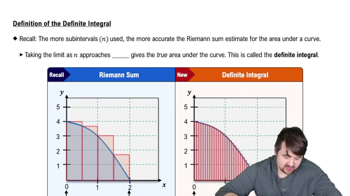
Definition of the Definite Integral

Graphing the Function ƒ(x) = 1/x

The function ƒ(x) = 1/x is a hyperbola with two branches, defined for x ≠ 0. It is positive and decreasing on the interval (0, ∞), approaching zero as x increases. Recognizing its shape and behavior helps in visualizing the area under the curve between points a, b, and c, which is crucial for sketching both ƒ and the area function A.
추천 영상:
03:39
Integrals of Natural Exponential Functions (e^x)

Relationship Between a Function and Its Area Function

The Fundamental Theorem of Calculus links a function ƒ and its area function A by stating that A'(x) = ƒ(x). This means the slope of the area function at any point x equals the value of ƒ at x. Understanding this relationship aids in graphing A by using the shape of ƒ and interpreting how the accumulated area changes over the interval.
추천 영상:
05:23
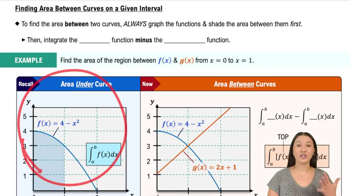
Finding Area Between Curves on a Given Interval
관련 실천
교과서 질문

{Use of Tech} Approximating definite integrals with a calculator Consider the following definite integrals.

(b) Evaluate each sum using a calculator with n = 20, 50, and 100. Use these values to estimate the value of the integral.


∫₀¹ (𝓍² + 1) d𝓍

80
views
교과서 질문

{Use of Tech} Riemann sums for larger values of n Complete the following steps for the given function f and interval.


ƒ(𝓍) = 3 √x on [0,4] ; n = 40

(b) Based on the approximations found in part (a), estimate the area of the region bounded by the graph of f and the x-axis on the interval.

66
views
교과서 질문

Matching functions with area functions Match the functions ƒ, whose graphs are given in a― d, with the area functions A (𝓍) = ∫₀ˣ ƒ(t) dt, whose graphs are given in A–D.


63
views
교과서 질문

{Use of Tech} Approximating net area The following functions are positive and negative on the given interval.


f(x) = sin 2x on [0,3π/4]


(b) Approximate the net area bounded by the graph of f and the x-axis on the interval using a left, right, and midpoint Riemann sum with n = 4.

55
views
교과서 질문

Properties of integrals Suppose ∫₀³ƒ(𝓍) d𝓍 = 2 , ∫₃⁶ƒ(𝓍) d𝓍 = ―5 , and ∫₃⁶g(𝓍) d𝓍 = 1. Evaluate the following integrals.

(b) ∫₃⁶ (―3g(𝓍)) d𝓍

38
views
교과서 질문

Properties of integrals Consider two functions ƒ and g on [1,6] such that ∫₁⁶ƒ(𝓍) d𝓍 = 10 and ∫₁⁶g(𝓍) d𝓍 = 5, ∫₄⁶ƒ(𝓍) d𝓍 = 5 , and ∫₁⁴g(𝓍) d𝓍 = 2. Evaluate the following integrals.


(b) ∫₁⁶ (f(𝓍) ― g(𝓍)) d𝓍

63
views