
Ch. 6 - Applications of Integration
Briggs - Calculus: Early Transcendentals 3rd Edition
Briggs3rd EditionCalculus: Early TranscendentalsISBN: 9780136847243당신이 사용하는 게 아니라요?교과서 변경
6장, 문제 6.5.20

9–20. Arc length calculations Find the arc length of the following curves on the given interval.
y = ln (x−√x²−1), for 1 ≤ x ≤ √2(Hint: Integrate with respect to y.)

검증된 단계별 안내
1
Recognize that the problem asks for the arc length of the curve defined by \(y = \ln \left(x - \sqrt{x^2 - 1}\right)\) on the interval \(1 \leq x \leq \sqrt{2}\). The hint suggests integrating with respect to \(y\), so consider expressing \(x\) as a function of \(y\) instead of \(y\) as a function of \(x\).
Start by rewriting the given function to find \(x\) in terms of \(y\). Since \(y = \ln \left(x - \sqrt{x^2 - 1}\right)\), exponentiate both sides to get \(e^y = x - \sqrt{x^2 - 1}\). Then solve this equation for \(x\).
After isolating \(x\), differentiate \(x\) with respect to \(y\) to find \(\frac{dx}{dy}\). This derivative will be used in the arc length formula when integrating with respect to \(y\).
Recall the arc length formula when integrating with respect to \(y\): \(L = \int_{y_1}^{y_2} \sqrt{1 + \left(\frac{dx}{dy}\right)^2} \, dy\). Determine the new limits of integration \(y_1\) and \(y_2\) by substituting the original \(x\)-values into the original function to find corresponding \(y\)-values.
Set up the integral for the arc length using the expression for \(\frac{dx}{dy}\) and the limits \(y_1\) and \(y_2\). The final step is to evaluate this integral to find the arc length, but per instructions, do not compute the final value here.

비슷한 문제에 대한 검증된 영상 답변:

이 영상 해법은 위 문제에 도움이 된다고 튜터들이 추천한 것입니다.
영상 길이:
6m

주요 개념

질문에 올바르게 답하기 위해 반드시 이해해야 하는 핵심 개념들은 다음과 같습니다.

Arc Length Formula

The arc length of a curve between two points is found by integrating the square root of 1 plus the derivative squared. When the curve is given as y = f(x), the formula is L = ∫√(1 + (dy/dx)²) dx. Alternatively, if integrating with respect to y, the formula becomes L = ∫√(1 + (dx/dy)²) dy.
추천 영상:
가이드 코스
06:29
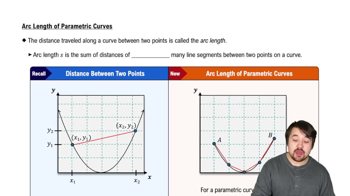
Arc Length of Parametric Curves

Inverse Hyperbolic Functions and Logarithms

The function y = ln(x − √(x² − 1)) is related to inverse hyperbolic functions, specifically the inverse hyperbolic cosine. Recognizing this helps simplify derivatives and integrals. Understanding the relationship between logarithmic and inverse hyperbolic functions aids in manipulating the expression for easier integration.
추천 영상:
5:26
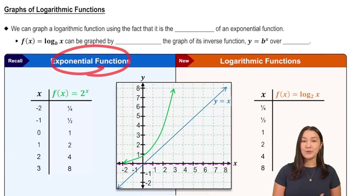
Graphs of Logarithmic Functions

Integration with Respect to y

Sometimes it is easier to compute arc length by integrating with respect to y instead of x, especially when the function or its inverse is simpler in terms of y. This requires expressing x as a function of y, finding dx/dy, and applying the arc length formula accordingly. This approach can simplify the integral and make it more manageable.
추천 영상:
06:30
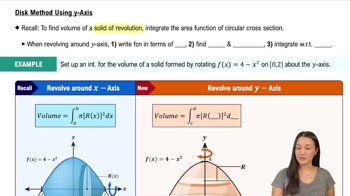
Disk Method Using y-Axis