Ch. 6 - Applications of Integration
Briggs - Calculus: Early Transcendentals 3rd Edition
Briggs3rd EditionCalculus: Early TranscendentalsISBN: 9780136847243당신이 사용하는 게 아니라요?교과서 변경
6장, 문제 6.7.60a

A vertical spring A 10-kg mass is attached to a spring that hangs vertically and is stretched 2 m from the equilibrium position of the spring. Assume a linear spring with F(x) = kx.
a. How much work is required to compress the spring and lift the mass 0.5 m?

검증된 단계별 안내
1
Identify the forces and displacements involved: The mass stretches the spring 2 m from its equilibrium position, so the spring constant \( k \) can be found using Hooke's Law \( F = kx \), where \( F \) is the weight of the mass and \( x \) is the displacement.
Calculate the spring constant \( k \) by setting the force equal to the weight of the mass: \( F = mg = kx \), where \( m = 10 \) kg, \( g = 9.8 \) m/s\^2, and \( x = 2 \) m. Rearrange to find \( k = \frac{mg}{x} \).
Determine the total displacement for the work calculation: compressing the spring and lifting the mass by 0.5 m means the spring is compressed from its stretched position by 0.5 m, so the new displacement from equilibrium is \( 2 - 0.5 = 1.5 \) m.
Set up the integral for the work done in compressing the spring from 2 m to 1.5 m using the formula for work done by a variable force: \( W = \int_{x_1}^{x_2} F(x) \, dx = \int_{1.5}^{2} kx \, dx \).
Evaluate the integral to find the work done: integrate \( kx \) with respect to \( x \) over the limits from 1.5 to 2, which gives \( W = \left[ \frac{kx^2}{2} \right]_{1.5}^{2} \). This expression represents the work required to compress the spring and lift the mass.

비슷한 문제에 대한 검증된 영상 답변:

이 영상 해법은 위 문제에 도움이 된다고 튜터들이 추천한 것입니다.
영상 길이:
3m

주요 개념

질문에 올바르게 답하기 위해 반드시 이해해야 하는 핵심 개념들은 다음과 같습니다.

Hooke's Law

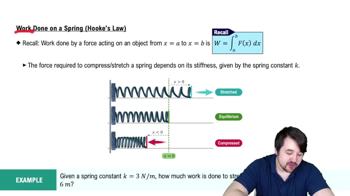
Hooke's Law states that the force exerted by a linear spring is proportional to its displacement from equilibrium, expressed as F(x) = kx, where k is the spring constant and x is the displacement. This relationship is fundamental for calculating forces and work involving springs.
추천 영상:
가이드 코스
05:40
Work Done On A Spring (Hooke's Law)

Work Done by a Variable Force

When a force varies with position, the work done is found by integrating the force over the displacement. For a spring, work is calculated as the integral of F(x) = kx from the initial to final position, representing the energy required to compress or stretch the spring.
추천 영상:
가이드 코스
05:40
Work Done On A Spring (Hooke's Law)

Gravitational Potential Energy

Lifting a mass against gravity increases its gravitational potential energy, calculated as mgh, where m is mass, g is acceleration due to gravity, and h is height. This energy must be included when determining the total work done in lifting the mass.
추천 영상:
05:59
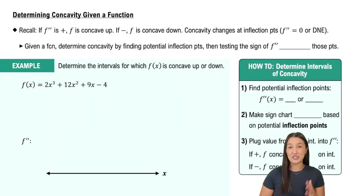
Determining Concavity Given a Function
관련 실천
교과서 질문

Given the velocity function of an object moving along a line, explain how definite integrals can be used to find the displacement of the object.

23
views
교과서 질문

6–8. Let R be the region bounded by the curves y = 2−√x,y=2, and x=4 in the first quadrant.


Suppose the shell method is used to determine the volume of the solid generated by revolving R about the line x=4.


a. What is the radius of a cylindrical shell at a point x in [0, 4]?

59
views
교과서 질문

Let R be the region in the first quadrant bounded above by the curve y=2−x² and bounded below by the line y=x. Suppose the shell method is used to determine the volume of the solid generated by revolving R about the y-axis.

b. What is the height of a cylindrical shell at a point x in [0, 2]?

138
views
교과서 질문

13–16. Displacement from velocity Consider an object moving along a line with the given velocity v. Assume time t is measured in seconds and velocities have units of m/s.


b. Find the displacement over the given interval. 


v(t) = 50e^−2t on [0, 4]

30
views
교과서 질문

21–30. {Use of Tech} Arc length by calculator


b. If necessary, use technology to evaluate or approximate the integral.

y = cos 2x, for 0 ≤ x ≤ π

49
views
교과서 질문

Emptying a water trough A water trough has a semicircular cross section with a radius of 0.25 m and a length of 3 m (see figure).

a. How much work is required to pump the water out of the trough (to the level of the top of the trough) when it is full?

65
views