Ch. 6 - Applications of Integration
Briggs - Calculus: Early Transcendentals 3rd Edition
Briggs3rd EditionCalculus: Early TranscendentalsISBN: 9780136847243당신이 사용하는 게 아니라요?교과서 변경
6장, 문제 6.2.59

Find the area of the region described in the following exercises.


The region bounded by x=y(y−1) and y=x/3

검증된 단계별 안내
1
Step 1: Identify the curves that bound the region. The first curve is given as \( x = y(y - 1) \), which can be rewritten as \( x = y^2 - y \). The second curve is \( y = \frac{x}{3} \).
Step 2: Find the points of intersection between the two curves. To do this, substitute \( y = \frac{x}{3} \) into \( x = y^2 - y \). Replace \( y \) with \( \frac{x}{3} \) to get \( x = \left(\frac{x}{3}\right)^2 - \frac{x}{3} \). Solve this equation for \( x \) to determine the limits of integration.
Step 3: Set up the integral to calculate the area. The region is bounded vertically, so express the area as \( \int_{x_1}^{x_2} \left( \text{top curve} - \text{bottom curve} \right) dx \). Here, the top curve is \( y = \frac{x}{3} \) and the bottom curve is \( y = \sqrt{x + x^2} \) (after solving for \( y \) in terms of \( x \)).
Step 4: Determine the limits of integration \( x_1 \) and \( x_2 \) from the points of intersection found in Step 2. These values will serve as the bounds for the integral.
Step 5: Evaluate the integral \( \int_{x_1}^{x_2} \left( \frac{x}{3} - \sqrt{x + x^2} \right) dx \) to find the area of the region. Break the integral into manageable parts if necessary, and simplify before solving.

비슷한 문제에 대한 검증된 영상 답변:

이 영상 해법은 위 문제에 도움이 된다고 튜터들이 추천한 것입니다.
영상 길이:
5m

주요 개념

질문에 올바르게 답하기 위해 반드시 이해해야 하는 핵심 개념들은 다음과 같습니다.

Defining the Region

To find the area of a region bounded by curves, it is essential to first understand the equations of the curves involved. In this case, the curves are given by x = y(y - 1) and y = x/3. Identifying the points of intersection between these curves will help determine the limits of integration for calculating the area.
추천 영상:
가이드 코스
07:45
Area of Polar Regions

Integration

Integration is a fundamental concept in calculus used to calculate the area under curves. Once the region is defined by the intersection points, the area can be found by setting up an integral. Depending on the orientation of the curves, this may involve integrating with respect to x or y, which requires understanding how to express the functions appropriately.
추천 영상:
가이드 코스
06:18
Integration by Parts for Definite Integrals

Area Between Curves

The area between two curves can be calculated by integrating the difference of the functions that define the upper and lower bounds of the region. In this case, once the curves are expressed in a suitable form, the area can be computed by integrating the difference between the two functions over the interval defined by their points of intersection.
추천 영상:
05:23
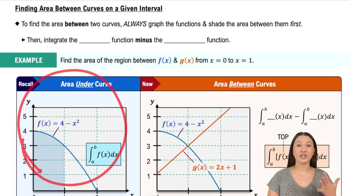
Finding Area Between Curves on a Given Interval
관련 실천
교과서 질문

Let R be the region bounded by the following curves. Find the volume of the solid generated when R is revolved about the given axis.


y=√sin x,y=1, and x=0; about the x-axis 

67
views

교과서 질문

60–63. Equivalent constant velocity Consider the following velocity functions. In each case, complete the sentence: The same distance could have been traveled over the given time period at a constant velocity of ________.


v(t) = t(25−t²)^1/2, for 0≤t≤5

31
views
교과서 질문

9–20. Arc length calculations Find the arc length of the following curves on the given interval.

y = −8x−3 on [−2, 6] (Use calculus.)

38
views
교과서 질문

9–12. Consider the cylindrical tank in Example 4 that has a height of 10 m and a radius of 5 m. Recall that if the tank is full of water, then ∫₀¹⁰ 25 π ρg(15−y) dy equals the work required to pump all the water out of the tank, through an outflow pipe that is 15 m above the bottom of the tank. Revise this work integral for the following scenarios. (Do not evaluate the integrals.)


The work required to empty the top half of the tank

91
views
교과서 질문

9-34. Shell method Let R be the region bounded by the following curves. Use the shell method to find the volume of the solid generated when R is revolved about indicated axis. 


{Use of Tech} y = √sin^−1x,y = √π/2, and x=0; about the x-axis

42
views
교과서 질문

For the following regions R, determine which is greater—the volume of the solid generated when R is revolved about the x-axis or about the y-axis.


R is bounded by y=1−x^3, the x-axis, and the y-axis.

100
views