Ch. 6 - Applications of Integration
Briggs - Calculus: Early Transcendentals 3rd Edition
Briggs3rd EditionCalculus: Early TranscendentalsISBN: 9780136847243당신이 사용하는 게 아니라요?교과서 변경
6장, 문제 6.3.6b

Let R be the region bounded by the curve y=cos^−1x and the x-axis on [0, 1]. A solid of revolution is obtained by revolving R about the y-axis (see figures). 


b. Find an expression for the area A(y) of a cross section of the solid at a point y in [0,π/2]. 

검증된 단계별 안내
1
Identify the region R bounded by the curve \(y = \cos^{-1} x\) and the x-axis on the interval \([0,1]\). Since \(y = \cos^{-1} x\), we can rewrite this as \(x = \cos y\) for \(y\) in \([0, \frac{\pi}{2}]\) because \(\cos^{-1} x\) maps \([0,1]\) to \([0, \frac{\pi}{2}]\).
Understand that the solid is formed by revolving the region R about the y-axis. For a fixed \(y\) in \([0, \frac{\pi}{2}]\), the cross section perpendicular to the y-axis is a circle.
Determine the radius of the cross-sectional circle at height \(y\). Since the solid is revolved around the y-axis, the radius is the horizontal distance from the y-axis to the curve, which is \(x = \cos y\).
Write the formula for the area \(A(y)\) of the cross section at height \(y\). The area of a circle is \(\pi\) times the radius squared, so \(A(y) = \pi (\cos y)^2\).
Express the final formula for the cross-sectional area as \(A(y) = \pi \cos^2 y\) for \(y\) in \([0, \frac{\pi}{2}]\).

비슷한 문제에 대한 검증된 영상 답변:

이 영상 해법은 위 문제에 도움이 된다고 튜터들이 추천한 것입니다.
영상 길이:
3m

주요 개념

질문에 올바르게 답하기 위해 반드시 이해해야 하는 핵심 개념들은 다음과 같습니다.

Inverse Trigonometric Functions

The function y = cos⁻¹(x) is the inverse cosine function, which maps values from [0,1] to angles in [0, π/2]. Understanding its domain and range is essential to relate x and y coordinates and to express x as a function of y when analyzing the region and cross sections.
추천 영상:
06:35
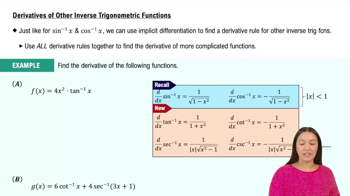
Derivatives of Other Inverse Trigonometric Functions

Cross-Sectional Area of a Solid of Revolution

A cross section perpendicular to the axis of revolution is a shape whose area depends on the distance from the axis. For revolution about the y-axis, the cross section at height y is typically a disk or washer, and its area A(y) can be found using the radius determined by the x-values corresponding to y.
추천 영상:
05:38
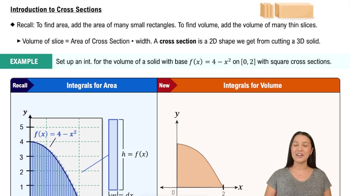
Introduction to Cross Sections

Relationship Between x and y in the Region

Since y = cos⁻¹(x), we can rewrite x in terms of y as x = cos(y). This relationship allows us to express the radius of the cross section at height y, which is crucial for setting up the area formula A(y) for the solid's cross section.
추천 영상:
05:23
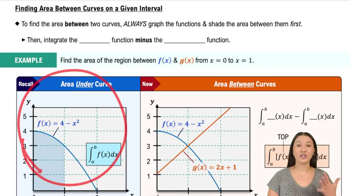
Finding Area Between Curves on a Given Interval
관련 실천
교과서 질문

Use the region R that is bounded by the graphs of y=1+√x,x=4, and y=1 complete the exercises.


Region R is revolved about the x-axis to form a solid of revolution whose cross sections are washers.


b. What is the inner radius of a cross section of the solid at a point x in [0, 4]?

57
views
교과서 질문

Winding a chain A 30-m-long chain hangs vertically from a cylinder attached to a winch. Assume there is no friction in the system and the chain has a density of 5kg/m.

b. How much work is required to wind the chain onto the cylinder if a 50-kg block is attached to the end of the chain?

39
views
교과서 질문

Consider the following curves on the given intervals.  


b. Use a calculator or software to approximate the surface area.


y=cos x, for 0≤x≤π/2; about the x-axis

62
views
교과서 질문

"Determine whether the following statements are true and give an explanation or counterexample.


b. The volume of a hemisphere can be computed using the disk method. "

68
views
교과서 질문

21–30. {Use of Tech} Arc length by calculator


b. If necessary, use technology to evaluate or approximate the integral.

y = cos 2x, for 0 ≤ x ≤ π

49
views
교과서 질문

Oscillating growth rates Some species have growth rates that oscillate with an (approximately) constant period P. Consider the growth rate function N'(t) = r+A sin 2πt/P, where A and r are constants with units of individuals/yr, and t is measured in years. A species becomes extinct if its population ever reaches 0 after t=0.


b. Suppose P=10, A=20, and r=0. If the initial population is N(0)=100, does the population ever become extinct? Explain.

51
views