


Ch. 6 - Applications of Integration
Briggs - Calculus: Early Transcendentals 3rd Edition
Briggs3rd EditionCalculus: Early TranscendentalsISBN: 9780136847243당신이 사용하는 게 아니라요?교과서 변경
6장, 문제 6.1.28c

Probe speed A data collection probe is dropped from a stationary balloon, and it falls with a velocity (in m/s) given by v(t) = 9.8t, neglecting air resistance. After 10 s, a chute deploys and the probe immediately slows to a constant speed of 10 m/s, which it maintains until it enters the ocean.


c. If the probe was released from an altitude of 3 km, when does it enter the ocean?

검증된 단계별 안내
1
First, understand the problem: the probe falls freely with velocity \(v(t) = 9.8t\) m/s for the first 10 seconds, then slows instantly to a constant velocity of 10 m/s until it reaches the ocean, starting from an altitude of 3000 meters.
Calculate the distance fallen during the first 10 seconds by integrating the velocity function \(v(t) = 9.8t\) over the interval from \(t=0\) to \(t=10\). This gives the displacement \(s_1\) during free fall:
\[ s_1 = \int_0^{10} 9.8t \, dt \]
Evaluate the integral to find \(s_1\), which represents how far the probe has fallen in the first 10 seconds.
Determine the remaining distance to the ocean after 10 seconds by subtracting \(s_1\) from the initial altitude (3000 m). Then, find the time \(t_2\) it takes to cover this remaining distance at the constant speed of 10 m/s:
\[ t_2 = \frac{3000 - s_1}{10} \]
Finally, add the initial 10 seconds to \(t_2\) to find the total time \(T\) when the probe enters the ocean:
\[ T = 10 + t_2 \]

비슷한 문제에 대한 검증된 영상 답변:

이 영상 해법은 위 문제에 도움이 된다고 튜터들이 추천한 것입니다.
영상 길이:
4m

주요 개념

질문에 올바르게 답하기 위해 반드시 이해해야 하는 핵심 개념들은 다음과 같습니다.

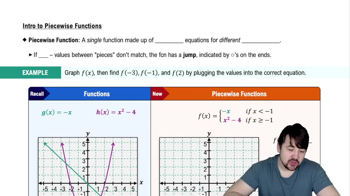
Piecewise Functions in Motion

The velocity of the probe changes at a specific time, requiring the use of piecewise functions to model its motion. Before 10 seconds, velocity increases linearly with time; after 10 seconds, velocity is constant. Understanding how to handle different function definitions over intervals is essential to analyze total displacement.
추천 영상:
가이드 코스
05:36
Piecewise Functions

Integration to Find Displacement

Displacement is found by integrating the velocity function over time. For variable velocity, the integral sums the area under the velocity-time curve, representing distance traveled. Calculating displacement before and after the chute deploys involves integrating each velocity segment separately.
추천 영상:
가이드 코스
06:18
Integration by Parts for Definite Integrals

Solving for Time Using Total Displacement

To find when the probe hits the ocean, set the total displacement equal to the initial altitude (3 km) and solve for time. This involves summing distances from both motion phases and solving the resulting equation, often requiring algebraic manipulation or numerical methods.
추천 영상:
5:47
Solving Exponential Equations Using Logs
관련 실천
교과서 질문

A nonlinear spring Hooke’s law is applicable to idealized (linear) springs that are not stretched or compressed too far from their equilibrium positions. Consider a nonlinear spring whose restoring force is given by F(x) = 16x−0.1x³, for |x|≤7. 

c. How much work is done in compressing the spring from its equilibrium position (x=0) to x=−2?

89
views
교과서 질문

Determine whether the following statements are true and give an explanation or counterexample. 


c. Let f(x)=12x^2. The area of the surface generated when the graph of f on [−4, 4] is revolved about the x-axis is twice the area of the surface generated when the graph of f on [0, 4] is revolved about the x-axis. 

65
views
교과서 질문

Let R be the region in the first quadrant bounded above by the curve y=2−x² and bounded below by the line y=x. Suppose the shell method is used to determine the volume of the solid generated by revolving R about the y-axis.

c. Write an integral for the volume of the solid using the shell method.

59
views
교과서 질문

13–16. Displacement from velocity Consider an object moving along a line with the given velocity v. Assume time t is measured in seconds and velocities have units of m/s.


c. Find the distance traveled over the given interval.


v(t) = 4t³ - 24t²+20t on [0, 5]

67
views
교과서 질문

Flow rates in the Spokane River The daily discharge of the Spokane River as it flows through Spokane, Washington, in April and June is modeled by the functions

r1(t) = 0.25t²+37.46t+722.47 (April) and

r2(t) = 0.90t²−69.06t+2053.12 (June), where the discharge is measured in millions of cubic feet per day, and t=0 corresponds to the beginning of the first day of the month (see figure).

c. The Spokane River flows out of Lake Coeur d’Alene, which contains approximately 0.67mi³ of water. Determine the percentage of Lake Coeur d’Alene’s volume that flows through Spokane in April and June.

32
views
교과서 질문

Determine whether the following statements are true and give an explanation or counterexample.


c. ∫₀¹(x−x^2) dx=∫₀¹(√y−y) dy

54
views