Atmospheric pressure The pressure of Earth’s atmosphere at sea level is approximately 1000 millibars and decreases exponentially with elevation. At an elevation of 30,000 ft (approximately the altitude of Mt. Everest), the pressure is one-third the sea-level pressure. At what elevation is the pressure half the sea-level pressure? At what elevation is it 1% of the sea-level pressure?
Ch. 7 - Logarithmic, Exponential Functions, and Hyperbolic Functions
모든 교과서
Briggs 3rd Edition
Ch. 7 - Logarithmic, Exponential Functions, and Hyperbolic Functions
문제 7.1.26
Briggs 3rd Edition
Ch. 7 - Logarithmic, Exponential Functions, and Hyperbolic Functions
문제 7.1.267장, 문제 7.1.26
Evaluate the following derivatives.
d/dx (x^{x¹⁰})
검증된 단계별 안내1
Step 1: Recognize that the function x^(x^10) is a composite function involving both a power and an exponential term. To differentiate it, use the logarithmic differentiation technique.
Step 2: Let y = x^(x^10). Take the natural logarithm of both sides: ln(y) = ln(x^(x^10)). Simplify using logarithmic properties: ln(y) = x^10 * ln(x).
Step 3: Differentiate both sides with respect to x. For the left-hand side, use implicit differentiation: (1/y) * dy/dx. For the right-hand side, apply the product rule to differentiate x^10 * ln(x).
Step 4: The derivative of x^10 * ln(x) is (x^10)' * ln(x) + x^10 * (ln(x))'. Compute these derivatives: (x^10)' = 10x^9 and (ln(x))' = 1/x.
Step 5: Substitute the derivatives back into the equation and solve for dy/dx. Multiply through by y (which is x^(x^10)) to express the derivative in terms of the original function.

비슷한 문제에 대한 검증된 영상 답변:
이 영상 해법은 위 문제에 도움이 된다고 튜터들이 추천한 것입니다.
영상 길이:
3m주요 개념
질문에 올바르게 답하기 위해 반드시 이해해야 하는 핵심 개념들은 다음과 같습니다.
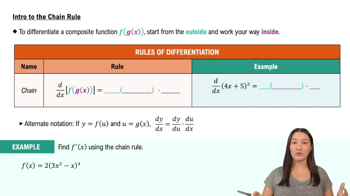
Chain Rule
The Chain Rule is a fundamental differentiation technique used to find the derivative of composite functions. It states that if a function y is composed of another function u, then the derivative of y with respect to x can be found by multiplying the derivative of y with respect to u by the derivative of u with respect to x. This rule is essential for evaluating derivatives of functions where one function is nested within another.
추천 영상:
Intro to the Chain Rule
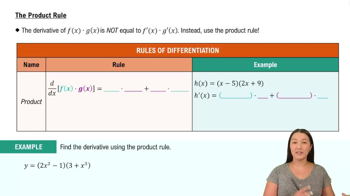
Product Rule
The Product Rule is a method for differentiating products of two functions. It states that if you have two functions u(x) and v(x), the derivative of their product is given by u'v + uv'. This rule is particularly useful when dealing with functions that are multiplied together, such as in the case of x raised to a power that is also a function of x.
추천 영상:
The Product Rule
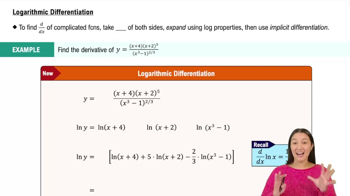
Exponential Functions and Logarithmic Differentiation
Exponential functions, particularly those of the form f(x) = x^g(x), can be differentiated using logarithmic differentiation. This technique involves taking the natural logarithm of both sides, which simplifies the differentiation process, especially when the exponent is a function of x. By applying the properties of logarithms, one can transform the expression into a more manageable form for differentiation.
추천 영상:
Logarithmic Differentiation
관련 실천
교과서 질문
160
views
교과서 질문
7–28. Derivatives Evaluate the following derivatives.
d/dx (x^{π})
68
views
교과서 질문
Bounds on e Use a left Riemann sum with at least n = 2 subintervals of equal length to approximate ln 2 = ∫[1 to 2] (dt/t) and show that ln 2 < 1. Use a right Riemann sum with n = 7 subintervals of equal length to approximate ln 3 = ∫[1 to 3] (dt/t) and show that ln 3 > 1.
30
views
교과서 질문
Evaluate ∫ 4ˣ dx.
72
views
교과서 질문
On what interval is the formula d/dx (tanh⁻¹ x) = 1/(1 - x²) valid?
72
views
교과서 질문
Suppose a quantity described by the function y(t) = y₀eᵏᵗ, where t is measured in years, has a doubling time of 20 years. Find the rate constant k.
57
views