
Ch. 9 - Differential Equations
Briggs - Calculus: Early Transcendentals 3rd Edition
Briggs3rd EditionCalculus: Early TranscendentalsISBN: 9780136847243당신이 사용하는 게 아니라요?교과서 변경
9장, 문제 9.5.23a

23–26. Stirred tank reactions For each of the following stirred tank reactions, carry out the following analysis.
a. Write an initial value problem for the mass of the substance.


A 500-L tank is initially filled with pure water. A copper sulfate solution with a concentration of 20 g/L flows into the tank at a rate of 4 L/min. The thoroughly mixed solution is drained from the tank at a rate of 4 L/min.

검증된 단계별 안내
1
Define the variable: Let \(m(t)\) represent the mass of copper sulfate (in grams) in the tank at time \(t\) (in minutes).
Identify the inflow rate of copper sulfate: The solution enters at 4 L/min with a concentration of 20 g/L, so the mass inflow rate is \(4 \times 20 = 80\) g/min.
Identify the outflow rate of copper sulfate: Since the tank is well mixed, the concentration inside the tank at time \(t\) is \(\frac{m(t)}{500}\) g/L. The outflow rate is 4 L/min, so the mass outflow rate is \(4 \times \frac{m(t)}{500} = \frac{4m(t)}{500}\) g/min.
Write the differential equation expressing the rate of change of mass in the tank: \(\frac{dm}{dt} = \) (mass inflow rate) $-$ (mass outflow rate), which gives \(\frac{dm}{dt} = 80 - \frac{4m(t)}{500}\).
Specify the initial condition: Since the tank is initially filled with pure water, the initial mass of copper sulfate is zero, so \(m(0) = 0\).

비슷한 문제에 대한 검증된 영상 답변:

이 영상 해법은 위 문제에 도움이 된다고 튜터들이 추천한 것입니다.
영상 길이:
3m

주요 개념

질문에 올바르게 답하기 위해 반드시 이해해야 하는 핵심 개념들은 다음과 같습니다.

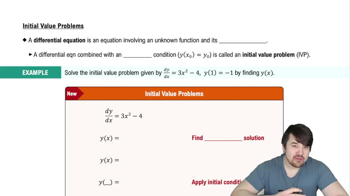
Formulating Initial Value Problems (IVPs)

An initial value problem involves setting up a differential equation that models the rate of change of a quantity along with an initial condition. In this context, it means expressing how the mass of copper sulfate in the tank changes over time, starting from zero since the tank initially contains pure water.
추천 영상:
가이드 코스
05:03
Initial Value Problems

Mass Balance in Continuous Stirred Tank Reactors (CSTR)

A mass balance accounts for the mass entering, leaving, and accumulating in the tank. For a stirred tank with inflow and outflow at equal rates, the change in mass equals the mass entering minus the mass leaving, assuming perfect mixing ensures uniform concentration throughout the tank.
추천 영상:
03:38
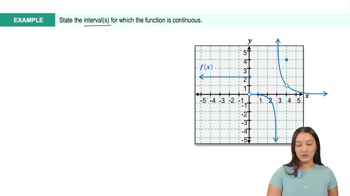
Intro to Continuity Example 1

Differential Equations for Concentration and Volume

The problem involves setting up a first-order linear differential equation relating the mass of solute to time, considering constant volume due to equal inflow and outflow rates. Concentration is mass divided by volume, and the inflow concentration and flow rate determine the input term in the equation.
추천 영상:
07:39
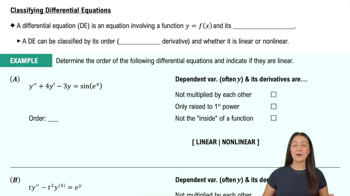
Classifying Differential Equations
관련 실천
교과서 질문

{Use of Tech} Logistic equation for spread of rumors Sociologists model the spread of rumors using logistic equations. The key assumption is that at any given time, a fraction y of the population, where 0≤y≤1, knows the rumor, while the remaining fraction 1−y does not. Furthermore, the rumor spreads by interactions between those who know the rumor and those who do not. The number of such interactions is proportional to y1−y. Therefore, the equation that describes the spread of the rumor is y′(t)=ky(1−y), for t≥0 where k is a positive real number and t is measured in weeks. The number of people who initially know the rumor is y(0)=y0, where 0≤y0≤1. 

a. Solve this initial value problem and give the solution in terms of k and y0.

63
views
교과서 질문

{Use of Tech} Analytical solution of the predator-prey equations The solution of the predator-prey equations

X'(t) = -ax + bxy,y’(t) = cy - dxy

can be viewed as parametric equations that describe the solution curves. Assume a, b, c, and d are positive constants and consider solutions in the first quadrant.


a. Recalling that dy/dx = y(t)/x′(t), divide the first equation by the second equation to obtain a separable differential equation in terms of x and y.

49
views
교과서 질문

U.S. population projections According to the U.S. Census Bureau, the nation’s population (to the nearest million) was 296 million in 2005 and 321 million in 2015. The Bureau also projects a 2050 population of 398 million. To construct a logistic model, both the growth rate and the carrying capacity must be estimated. There are several ways to estimate these parameters. Here is one approach:


a. Assume t = 0 corresponds to 2005 and that the population growth is exponential for the first ten years; that is, between 2005 and 2015, the population is given by P(t) = P(0)exp(rt). Estimate the growth rate r using this assumption.

134
views
교과서 질문

A second-order equation Consider the differential equation y''(t) - k²y(t) = 0 where k > 0 is a real number.


a. Verify by substitution that when k = 1, a solution of the equation is y(t) = C₁eᵗ + C₂e⁻ᵗ. You may assume this function is the general solution.

86
views
교과서 질문

Cooling time Suppose an object with an initial temperature of T₀ > 0 is put in surroundings with an ambient temperature of A, where A < T₀/2. Let t₁/₂ be the time required for the object to cool to T₀/2.


a. Show that t₁/₂ = −1/k ln((T₀ − 2A)/(2(T₀ − A))).

70
views
교과서 질문

42–43. Implicit solutions for separable equations For the following separable equations, carry out the indicated analysis.

a. Find the general solution of the equation.


y'(t) = t²/(y² + 1); y(−1) = 1, y(0) = 0, y(−1) = −1


55
views