Ch.12 - Parametric and Polar Curves
Briggs - Calculus: Early Transcendentals 3rd Edition
Briggs3rd EditionCalculus: Early TranscendentalsISBN: 9780136847243당신이 사용하는 게 아니라요?교과서 변경
12장, 문제 12.3.33

33–40. Areas of regions Make a sketch of the region and its bounding curves. Find the area of the region.


The region inside the curve r = √(cos θ)

검증된 단계별 안내
1
First, understand the curve given in polar coordinates: \(r = \sqrt{\cos \theta}\). Since \(r\) must be real, identify the domain of \(\theta\) where \(\cos \theta \geq 0\). This will help determine the bounds for integration.
Sketch the curve by plotting points for values of \(\theta\) within the domain found. Note that \(r\) is non-negative and depends on \(\cos \theta\), which is positive in the intervals \([-\frac{\pi}{2}, \frac{\pi}{2}]\) and \([\frac{3\pi}{2}, \frac{5\pi}{2}]\), but since \(r\) is defined as \(\sqrt{\cos \theta}\), focus on the principal interval where \(r\) is real and positive.
Recall the formula for the area enclosed by a polar curve between angles \(\alpha\) and \(\beta\) is \(A = \frac{1}{2} \int_{\alpha}^{\beta} r^2 \, d\theta\). Substitute \(r^2 = \cos \theta\) into this formula.
Set up the integral for the area as \(A = \frac{1}{2} \int_{-\frac{\pi}{2}}^{\frac{\pi}{2}} \cos \theta \, d\theta\), using the interval where \(r\) is real and positive.
Evaluate the integral by integrating \(\cos \theta\) over the interval, then multiply by \(\frac{1}{2}\). This will give the area of the region inside the curve.

비슷한 문제에 대한 검증된 영상 답변:

이 영상 해법은 위 문제에 도움이 된다고 튜터들이 추천한 것입니다.
영상 길이:
3m

주요 개념

질문에 올바르게 답하기 위해 반드시 이해해야 하는 핵심 개념들은 다음과 같습니다.

Polar Coordinates and Curves

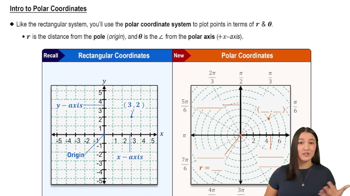
Polar coordinates represent points using a radius and an angle (r, θ). Curves defined in polar form, like r = √(cos θ), describe shapes based on these parameters. Understanding how to interpret and plot such curves is essential for visualizing the region whose area is to be found.
추천 영상:
05:32
Intro to Polar Coordinates

Area Calculation in Polar Coordinates

The area enclosed by a polar curve r(θ) from θ = a to θ = b is given by the integral (1/2) ∫[a to b] (r(θ))^2 dθ. This formula accounts for the sector-like slices of the region, making it crucial for finding areas bounded by polar curves.
추천 영상:
05:32
Intro to Polar Coordinates

Determining the Limits of Integration

To compute the area, one must identify the correct interval [a, b] for θ where the curve is defined and the region is enclosed. This often involves analyzing where r(θ) is real and non-negative, and where the curve completes a full loop or returns to the starting point.
추천 영상:
05:50
One-Sided Limits