Ch. 7 - Transcendental Functions
Hass - Thomas' Calculus 15th Edition
Hass15th EditionThomas' CalculusISBN: 9780137616077당신이 사용하는 게 아니라요?교과서 변경
7장, 문제 7.AAE.19

19. Center of mass Find the center of mass of a thin plate of constant density covering the region in the first and fourth quadrants enclosed by the curves y=1/(1+x²) and y=-1/(1+x²) and by the lines x=0 and x=1.

검증된 단계별 안내
1
Identify the region described: it lies between the curves \(y=\frac{1}{1+x^{2}}\) and \(y=-\frac{1}{1+x^{2}}\), bounded by the vertical lines \(x=0\) and \(x=1\). This region is symmetric about the x-axis and lies in the first and fourth quadrants.
Since the plate has constant density, denote the density by \(\rho\). The center of mass coordinates \((\bar{x}, \bar{y})\) are given by the formulas: \(\displaystyle \bar{x} = \frac{1}{M} \int x \, dm\) and \(\displaystyle \bar{y} = \frac{1}{M} \int y \, dm\), where \(M\) is the total mass of the plate.
Express the mass element \(dm\) in terms of \(dx\) and \(dy\). Because the plate is thin and has constant density, \(dm = \rho \, dA\), where \(dA\) is the differential area element. Here, \(dA\) can be expressed as the vertical slice between the two curves: \(\displaystyle dA = \left( \frac{1}{1+x^{2}} - \left(-\frac{1}{1+x^{2}}\right) \right) dx = \frac{2}{1+x^{2}} \, dx\).
Calculate the total mass \(M\) by integrating the area times density over \(x\) from 0 to 1: \(\displaystyle M = \rho \int_{0}^{1} \frac{2}{1+x^{2}} \, dx\).
Find the moments needed for the center of mass: - For \(\bar{x}\), compute \(\displaystyle \int x \, dm = \rho \int_{0}^{1} x \cdot \frac{2}{1+x^{2}} \, dx\). - For \(\bar{y}\), note the symmetry of the region about the x-axis: the positive and negative parts cancel out, so \(\bar{y} = 0\). Finally, use the formulas \(\bar{x} = \frac{1}{M} \int x \, dm\) and \(\bar{y} = 0\) to express the center of mass.

비슷한 문제에 대한 검증된 영상 답변:

이 영상 해법은 위 문제에 도움이 된다고 튜터들이 추천한 것입니다.
영상 길이:
11m

주요 개념

질문에 올바르게 답하기 위해 반드시 이해해야 하는 핵심 개념들은 다음과 같습니다.

Center of Mass for a Lamina

The center of mass of a thin plate (lamina) with constant density is the point where the plate would balance perfectly. It is found by calculating the coordinates (x̄, ȳ) using the moments about the y-axis and x-axis divided by the total mass (area times density). For constant density, the density factor cancels out, simplifying calculations to area and moments.
추천 영상:
가이드 코스
09:32
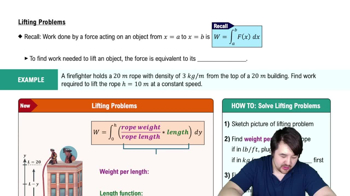
Lifting Problems

Setting up Double Integrals for Area and Moments

To find the center of mass, you compute the area and the moments using integrals over the given region. Since the region is bounded by curves and lines, you set up integrals with appropriate limits for x and y. The area integral gives the total mass, while the moment integrals involve multiplying coordinates by the density function (constant here) and integrating over the region.
추천 영상:
05:23
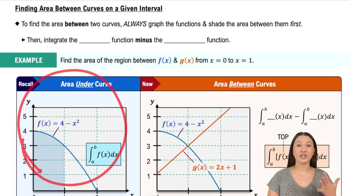
Finding Area Between Curves on a Given Interval

Symmetry and Its Effect on the Center of Mass

The given region is symmetric about the x-axis because the upper and lower boundaries are y = 1/(1+x²) and y = -1/(1+x²). This symmetry implies that the vertical coordinate of the center of mass (ȳ) is zero, simplifying the problem to finding only the horizontal coordinate (x̄). Recognizing symmetry reduces computational effort.
추천 영상:
가이드 코스
06:21
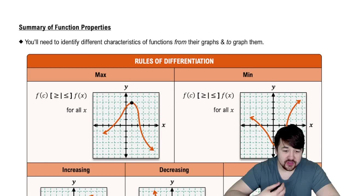
Properties of Functions