Ch. 8 - Techniques of Integration
Hass - Thomas' Calculus 15th Edition
Hass15th EditionThomas' CalculusISBN: 9780137616077당신이 사용하는 게 아니라요?교과서 변경
8장, 문제 8.4.61a

Evaluate ∫ x³ √(1 - x²) dx using:
a. Integration by parts.

검증된 단계별 안내
1
Identify the integral to solve: \(\int x^{3} \sqrt{1 - x^{2}} \, dx\).
For integration by parts, choose parts of the integrand as \(u\) and \(dv\). A good choice is to let \(u = x^{2}\) (since \(x^{3} = x \cdot x^{2}\)) and \(dv = x \sqrt{1 - x^{2}} \, dx\) to simplify the integral after differentiation and integration.
Compute \(du\) by differentiating \(u\): \(du = 2x \, dx\).
Find \(v\) by integrating \(dv\): \(v = \int x \sqrt{1 - x^{2}} \, dx\). To do this, use a substitution such as \(t = 1 - x^{2}\), then express \(v\) in terms of \(t\) and integrate.
Apply the integration by parts formula: \(\int u \, dv = uv - \int v \, du\). Substitute the expressions for \(u\), \(v\), and \(du\) into this formula to rewrite the original integral in terms of simpler integrals to evaluate.

비슷한 문제에 대한 검증된 영상 답변:

이 영상 해법은 위 문제에 도움이 된다고 튜터들이 추천한 것입니다.
영상 길이:
11m

주요 개념

질문에 올바르게 답하기 위해 반드시 이해해야 하는 핵심 개념들은 다음과 같습니다.

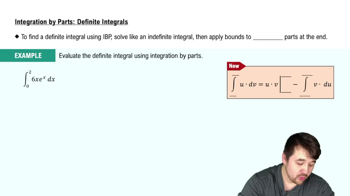
Integration by Parts

Integration by parts is a technique based on the product rule for differentiation. It transforms the integral of a product of functions into simpler integrals using the formula ∫u dv = uv - ∫v du. Choosing u and dv wisely simplifies the integral, especially when one function becomes simpler upon differentiation.
추천 영상:
가이드 코스
06:18
Integration by Parts for Definite Integrals

Substitution Method

Substitution involves changing variables to simplify an integral. By setting a part of the integrand as a new variable, the integral can be rewritten in a simpler form. This is particularly useful when the integrand contains composite functions, such as √(1 - x²), which suggests substituting u = 1 - x².
추천 영상:
07:33
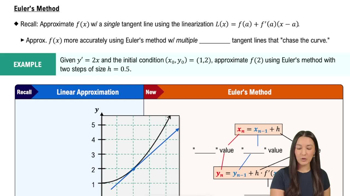
Euler's Method

Handling Powers and Roots in Integrals

Integrals involving powers and roots require careful algebraic manipulation. Expressing roots as fractional exponents and simplifying powers can make integration more straightforward. Recognizing how to rewrite expressions like √(1 - x²) as (1 - x²)^(1/2) helps in applying integration techniques effectively.
추천 영상:
05:58
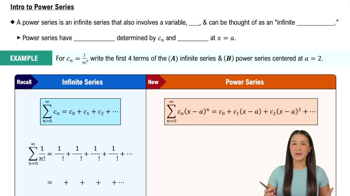
Intro to Power Series
관련 실천
교과서 질문

In Exercises 11–22, estimate the minimum number of subintervals needed to approximate the integrals with an error of magnitude less than 10^-4 by (a) the Trapezoidal Rule (The integrals in Exercises 11–18 are the integrals from Exercises 1–8.)

∫ from 1 to 3 of (2x - 1) dx

27
views
교과서 질문

In Exercises 11–22, estimate the minimum number of subintervals needed to approximate the integrals with an error of magnitude less than 10^-4 by (a) the Trapezoidal Rule (The integrals in Exercises 11–18 are the integrals from Exercises 1–8.)

∫ from 0 to 2 of sin(x + 1) dx

33
views
교과서 질문

In Exercises 11–22, estimate the minimum number of subintervals needed to approximate the integrals with an error of magnitude less than 10^-4 by (a) the Trapezoidal Rule (The integrals in Exercises 11–18 are the integrals from Exercises 1–8.)

∫ from 0 to 3 of 1/√(x + 1) dx

26
views
교과서 질문

Finding area

Find the area of the region enclosed by the curve y = x cos(x) and the x-axis (see the accompanying figure) for:

b. 3π/2 ≤ x ≤ 5π/2.

33
views
교과서 질문

Finding volume: Find the volume of the solid generated by revolving the region in the first quadrant bounded by the coordinate axes and the curve y = cos(x), 0 ≤ x ≤ π/2, about

b. The line x = π/2.

60
views
교과서 질문

In Exercises 11–22, estimate the minimum number of subintervals needed to approximate the integrals with an error of magnitude less than 10^-4 by (b) Simpson’s Rule. (The integrals in Exercises 11–18 are the integrals from Exercises 1–8.)

∫ from 0 to 3 of 1/√(x + 1) dx

25
views